


Page 113 - text book form physics kssm 2020
P. 113
Chapter 3
                                                                                                  Gravitation
                  Escape Velocity                                                     Escape velocity
                  Escape velocity, v is the minimum velocity needed by an object
                  on the surface of the Earth to overcome the gravitational force
                  and escape to outer space.

                        If the distance of an object from the centre of the Earth is r,   http://bt.sasbadi.com/p4107a
                  the mass of the object is m, and the mass of the Earth is M, then
                                                                     GMm
                  the object possesses gravitational potential energy, U = –   .
                                                                       r
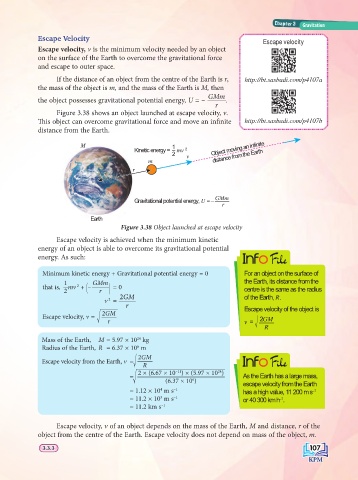
                        Figure 3.38 shows an object launched at escape velocity, v.
                  Th  is object can overcome gravitational force and move an infi nite   http://bt.sasbadi.com/p4107b
                  distance from the Earth.

                               M                           1
                                                           –
                                               Kinetic energy =     mv  2  Object moving an infinite
                                                           2   v       distance from the Earth
                                                   m
                                               r


                                               Gravitational potential energy, U = –  GMm
                                                                       –––––
                                                                          r
                                  Earth
                                           Figure 3.38 Object launched at escape velocity
                        Escape velocity is achieved when the minimum kinetic
                  energy of an object is able to overcome its gravitational potential
                  energy. As such:                                                      File

                    Minimum kinetic energy + Gravitational potential energy = 0  For an object on the surface of
                          1        GMm                                          the Earth, its distance from the

                    that is,  mv  +  –  r    = 0                                centre is the same as the radius
                              2
                          2
                                           2GM                                  of the Earth, R.
                                       2
                                      v  =
                                             r                                  Escape velocity of the object is

                                     2GM
                    Escape velocity, v =                                             2GM

                                       r                                        v =
                                                                                      R
                                                24
                   Mass of the Earth,  M = 5.97 × 10  kg
                                                6
                   Radius of the Earth,  R  = 6.37 × 10  m
                                                                                        File
                                                2GM
                   Escape velocity from the Earth, v =    R
                                                                                As the Earth has a large mass,
                                                                        24
                                                            –11
                                                2 × (6.67 × 10 ) × (5.97 × 10 )
                                              =                  6
                                                         (6.37 × 10 )
                                                                                escape velocity from the Earth
                                                       4
                                              = 1.12 × 10  m s –1               has a high value, 11 200 m s
                                                                                                     –1
                                                       3
                                              = 11.2 × 10  m s –1               or 40 300 km h .
                                                                                           –1
                                              = 11.2 km s –1
                        Escape  velocity, v of an object depends on the mass of the Earth, M and distance, r of the
                  object from the centre of the Earth. Escape velocity does not depend on mass of the object, m.
                                                                                                    107
                    3.3.3                                                                           107
                    3.3.3

