


Page 110 - text book form physics kssm 2020
P. 110
As GM is constant, linear speed of the satellite only depends on the radius of its orbit. If a
                 satellite is at a height, h above the surface of the Earth,

                                        Radius of its orbit, r = R + h
                                        that is R = radius of the Earth
                                                                            GM
                                        Th  erefore, linear speed of the satellite, v =
                                                                           R + h


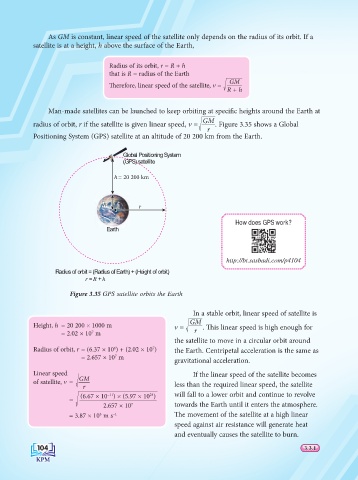
                     Man-made satellites can be launched to keep orbiting at specifi c heights around the Earth at

                                                                    GM
                 radius of orbit, r if the satellite is given linear speed, v =    . Figure 3.35 shows a Global
                                                                     r
                 Positioning System (GPS) satellite at an altitude of 20 200 km from the Earth.

                                            Global Positioning System
                                            (GPS) satellite

                                         h  = 20 200 km


                                      R R        r

                                                                              How does GPS work?
                                       Earth


                                                                           http://bt.sasbadi.com/p4104
                       Radius of orbit = (Radius of Earth) + (Height of orbit)
                                r = R + h
                            Figure 3.35 GPS satellite orbits the Earth


                                                                 In a stable orbit, linear speed of satellite is
                                                                GM
                 Height, h  = 20 200 × 1000 m              v =    . Th  is linear speed is high enough for
                         = 2.02 × 10  m                          r
                                  7
                                                           the satellite to move in a circular orbit around
                                         6
                 Radius of orbit, r = (6.37 × 10 ) + (2.02 × 10 )   the Earth. Centripetal acceleration is the same as
                                                     7
                                         7
                               = 2.657 × 10  m
                                                           gravitational acceleration.
                 Linear speed                                    If the linear speed of the satellite becomes
                 of satellite, v =
                               GM
                                r                          less than the required linear speed, the satellite
                                                           will fall to a lower orbit and continue to revolve
                               (6.67 × 10 ) × (5.97 × 10 )
                                       –11
                                                    24
                            =
                                      2.657 × 10 7         towards the Earth until it enters the atmosphere.
                                     3
                            = 3.87 × 10  m s –1            Th  e movement of the satellite at a high linear
                                                           speed against air resistance will generate heat
                                                           and eventually causes the satellite to burn.
                  104                                                                             3.3.1
                  104
                                                                                                  3.3.1

