


Page 149 - text book form physics kssm 2020
P. 149
Chapter 4
                                                                                                     Heat
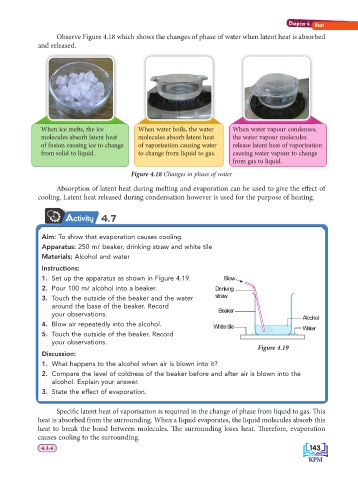
                        Observe Figure 4.18 which shows the changes of phase of water when latent heat is absorbed
                  and released.


                   When ice melts, the ice      When water boils, the water   When water vapour condenses,
                   molecules absorb latent heat   molecules absorb latent heat   the water vapour molecules
                   of fusion causing ice to change   of vaporisation causing water   release latent heat of vaporisation
                   from solid to liquid.        to change from liquid to gas.  causing water vapour to change
                                                                             from gas to liquid.

                                              Figure 4.18 Changes in phase of water
                        Absorption of latent heat during melting and evaporation can be used to give the eff ect of
                  cooling. Latent heat released during condensation however is used for the purpose of heating.


                           Activity 4.7

                   Aim: To show that evaporation causes cooling
                   Apparatus: 250 ml beaker, drinking straw and white tile
                   Materials: Alcohol and water
                   Instructions:
                   1.  Set up the apparatus as shown in Figure 4.19.      Blow
                   2.  Pour 100 ml alcohol into a beaker.               Drinking
                   3.  Touch the outside of the beaker and the water    straw
                      around the base of the beaker. Record
                      your observations.                                Beaker                    Alcohol
                   4.  Blow air repeatedly into the alcohol.           White tile                 Water
                   5.  Touch the outside of the beaker. Record
                      your observations.
                   Discussion:                                                      Figure 4.19
                   1.  What happens to the alcohol when air is blown into it?
                   2.  Compare the level of coldness of the beaker before and after air is blown into the
                      alcohol. Explain your answer.
                   3.  State the effect of evaporation.


                        Specifi c latent heat of vaporisation is required in the change of phase from liquid to gas. Th is
                  heat is absorbed from the surrounding. When a liquid evaporates, the liquid molecules absorb this
                  heat to break the bond between molecules. Th  e surrounding loses heat. Th erefore, evaporation
                  causes cooling to the surrounding.
                                                                                                    143
                   4.3.4
                   4.3.4                                                                            143

