


Page 173 - text book form physics kssm 2020
P. 173
Chapter 4
                                                                                                     Heat
                      8.  Air in the tyre of a car has a pressure of 220 kPa at initial temperature of 27°C. Aft er a
                                                                o
                       race, the temperature of the air increases to 87 C.
                       (a)  Calculate the air pressure in the tyre aft er the race.
                       (b)  What assumptions did you make in 8(a)?

                    9.  An air bubble is trapped under a leaf fl oating on the water surface of a lake. Th  e volume of
                                           3
                       the air bubble is 3.6 cm  when the temperature is 20°C.
                       (a)  What is the volume of the air bubble when the water temperature rises to 38°C?
                       (b)  State three assumptions that need to be made in your calculations in 9(a).

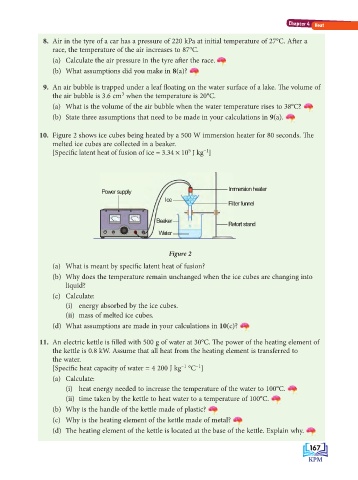
                    10.  Figure 2 shows ice cubes being heated by a 500 W immersion heater for 80 seconds. Th e
                       melted ice cubes are collected in a beaker.
                                                               5
                                                                    –1
                       [Specifi c latent heat of fusion of ice = 3.34 × 10  J kg ]


                                     Power supply                          Immersion heater
                                                        Ice
                                                                           Filter funnel

                                                      Beaker
                                                                           Retort stand
                                                       Water


                                                          Figure 2
                       (a)   What is meant by specifi c latent heat of fusion?
                       (b)  Why does the temperature remain unchanged when the ice cubes are changing into
                           liquid?
                       (c)   Calculate:
                           (i)   energy absorbed by the ice cubes.
                           (ii)  mass of melted ice cubes.
                       (d)  What assumptions are made in your calculations in 10(c)?

                    11.  An electric kettle is fi lled with 500 g of water at 30°C. Th  e power of the heating element of
                       the kettle is 0.8 kW. Assume that all heat from the heating element is transferred to
                       the water.
                                                             –1
                                                                  –1
                       [Specifi c heat capacity of water = 4 200 J kg  °C ]
                       (a) Calculate:
                           (i)  heat energy needed to increase the temperature of the water to 100°C.
                           (ii)  time taken by the kettle to heat water to a temperature of 100°C.
                       (b)  Why is the handle of the kettle made of plastic?
                       (c)  Why is the heating element of the kettle made of metal?
                       (d) Th  e heating element of the kettle is located at the base of the kettle. Explain why.

                                                                                                    167
                                                                                                    167

