


Page 178 - text book form physics kssm 2020
P. 178
5.1      Fundamentals of W
                          Fundamentals of Wavesaves


                 Waves

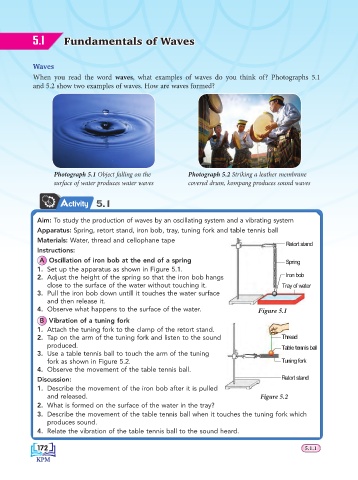
                 When you read the word  waves, what examples of waves do you think of? Photographs 5.1
                 and 5.2 show two examples of waves. How are waves formed?


                       Photograph 5.1 Object falling on the    Photograph 5.2 Striking a leather membrane
                       surface of water produces water waves   covered drum, kompang produces sound waves


                         Activity 5.1

                  Aim: To study the production of waves by an oscillating system and a vibrating system
                  Apparatus: Spring, retort stand, iron bob, tray, tuning fork and table tennis ball
                  Materials: Water, thread and cellophane tape                               Retort stand
                  Instructions:
                   A  Oscillation of iron bob at the end of a spring                         Spring
                  1.  Set up the apparatus as shown in Figure 5.1.
                  2.  Adjust the height of the spring so that the iron bob hangs             Iron bob
                     close to the surface of the water without touching it.                 Tray of water
                  3.  Pull the iron bob down untill it touches the water surface
                     and then release it.
                  4.  Observe what happens to the surface of the water.             Figure 5.1
                   B  Vibration of a tuning fork
                  1.  Attach the tuning fork to the clamp of the retort stand.
                  2.  Tap on the arm of the tuning fork and listen to the sound            Thread
                     produced.                                                             Table tennis ball
                  3.  Use a table tennis ball to touch the arm of the tuning
                     fork as shown in Figure 5.2.                                          Tuning fork
                  4.  Observe the movement of the table tennis ball.
                  Discussion:                                                              Retort stand
                  1.  Describe the movement of the iron bob after it is pulled
                     and released.                                                   Figure 5.2
                  2.  What is formed on the surface of the water in the tray?
                  3.  Describe the movement of the table tennis ball when it touches the tuning fork which
                     produces sound.
                  4.  Relate the vibration of the table tennis ball to the sound heard.

                  172                                                                             5.1.1
                  172
                  172
                  172
                                                                                                  5.1.1

