


Page 183 - text book form physics kssm 2020
P. 183
Chapter 5
                                                                                                   Waves
                                                                                        File
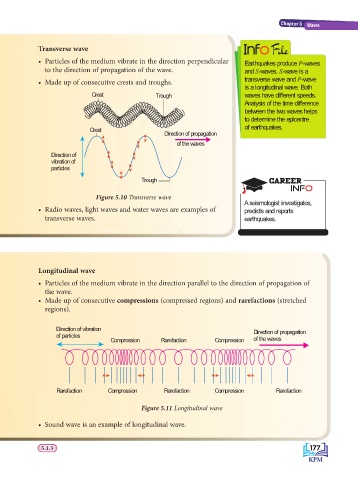
                  Transverse wave
                  •  Particles of the medium vibrate in the direction perpendicular   Earthquakes produce P-waves
                    to the direction of propagation of the wave.                and S-waves. S-wave is a
                                                                                transverse wave and P-wave
                  •  Made up of consecutive crests and troughs.
                                                                                is a longitudinal wave. Both
                                  Crest               Trough                    waves have different speeds.
                                                                                Analysis of the time difference
                                                                                between the two waves helps
                                                                                to determine the epicentre
                                  Crest                                         of earthquakes.
                                                        Direction of propagation
                                                            of the waves
                      Direction of
                      vibration of
                      particles

                                                 Trough                                 CAREER
                                                                                              iNFO
                                    Figure 5.10 Transverse wave
                                                                                A seismologist investigates,
                  •  Radio waves, light waves and water waves are examples of   predicts and reports
                    transverse waves.                                           earthquakes.


                  Longitudinal wave
                  •  Particles of the medium vibrate in the direction parallel to the direction of propagation of
                    the wave.
                  •  Made up of consecutive compressions (compressed regions) and rarefactions (stretched
                    regions).


                        Direction of vibration                                     Direction of propagation
                        of particles
                                        Compression    Rarefaction     Compression  of the waves


                        Rarefaction    Compression      Rarefaction    Compression        Rarefaction


                                                 Figure 5.11 Longitudinal wave

                  •  Sound wave is an example of longitudinal wave.


                                                                                                    177
                                                                                                    177
                                                                                                    177
                   5.1.3
                   5.1.3                                                                            177

