


Page 255 - text book form physics kssm 2020
P. 255
Chapter 6
                                                                                               Light and Optics
                  Solving Problems Involving Total Internal Reflection

                    Example 1
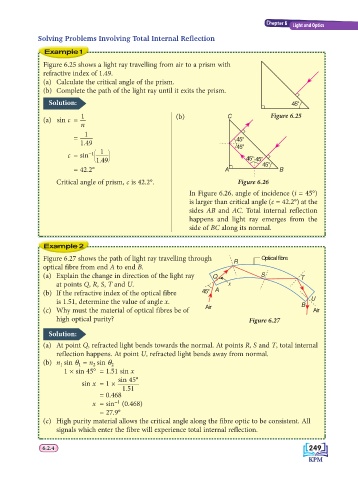
                    Figure 6.25 shows a light ray travelling from air to a prism with
                    refractive index of 1.49.
                    (a)  Calculate the critical angle of the prism.
                    (b)  Complete the path of the light ray until it exits the prism.
                     Solution:                                                                 45°

                               1                            (b)            C
                    (a) sin c =                                                         Figure 6.25
                               n
                                1
                             =                                                45°
                               1.49                                           45°
                                     1
                           c = sin −1   1.49                                     45°  45°

                             = 42.2°                                      A           45°  B
                        Critical angle of prism, c is 42.2°.                  Figure 6.26
                                                                In Figure 6.26, angle of incidence (i = 45°)
                                                                is larger than critical angle (c = 42.2°) at the
                                                                sides  AB and  AC. Total internal reflection
                                                                happens and light ray emerges from the
                                                                side of BC along its normal.

                    Example 2

                    Figure 6.27 shows the path of light ray travelling through   R   Optical fibre
                    optical fibre from end A to end B.
                    (a)  Explain the change in direction of the light ray   Q        S           T
                        at points Q, R, S, T and U.                        x
                    (b)  If the refractive index of the optical fibre   45°  A
                        is 1.51, determine the value of angle x.                                 B  U
                    (c)  Why must the material of optical fibres be of   Air                         Air
                        high optical purity?
                                                                                  Figure 6.27
                     Solution:

                    (a)   At point Q, refracted light bends towards the normal. At points R, S and T, total internal
                        reflection happens. At point U, refracted light bends away from normal.
                    (b)  n sin θ  = n sin θ 2
                                   2
                         1
                              1
                          1 × sin 45°  = 1.51 sin x
                                          sin 45°
                               sin x  = 1 ×
                                            1.51
                                     = 0.468
                                         −1
                                   x = sin  (0.468)
                                     = 27.9°
                    (c)   High purity material allows the critical angle along the fibre optic to be consistent. All
                        signals which enter the fibre will experience total internal reflection.

                                                                                                    249
                    6.2.4                                                                           249
                    6.2.4

