


Page 71 - text book form physics kssm 2020
P. 71
Chapter 2  Force and Motion I


                   3.  Calculate the acceleration of the trolley from the ticker      Two elastic strings
                      tape obtained and record it in Table 2.11.
                   4.  Plot a graph of acceleration, a against the reciprocal of mass,
                       1  and state the relationship between acceleration, a and               Two trolleys
                       m
                      mass, m.
                                                                                        Figure 2.52
                   Results:


                                                         Table 2.11
                           Mass           u / cm s –1     v / cm s –1       t / s         a / cm s –2
                        1 trolley, m
                       2 trolleys, 2m
                       3 trolleys, 3m


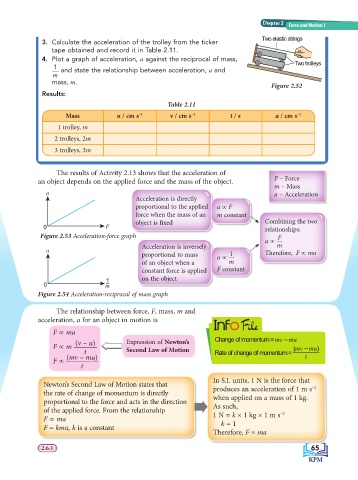
                        The results of Activity 2.13 shows that the acceleration of
                                                                                         F – Force
                  an object depends on the applied force and the mass of the object.
                                                                                         m – Mass
                     a                                                                   a – Acceleration
                                                Acceleration is directly
                                                proportional to the applied   a ∝ F
                                                force when the mass of an   m constant
                                                object is fixed                       Combining the two
                    0                  F                                              relationships:
                   Figure 2.53 Acceleration-force graph                                   F
                                                                                      a ∝
                                                 Acceleration is inversely                m
                     a                                                                Therefore,  F ∝ ma
                                                 proportional to mass       1
                                                                        a ∝
                                                 of an object when a        m
                                                 constant force is applied   F constant
                                       1         on the object
                                       –
                    0                 m
                  Figure 2.54 Acceleration-reciprocal of mass graph
                        The relationship between force, F, mass, m and
                  acceleration, a for an object in motion is                   File
                       F ∝ ma
                             (v – u)         Expression of Newton’s    Change of momentum = mv – mu
                       F ∝ m                                                                   (mv – mu)
                                t            Second Law of Motion      Rate of change of momentum =
                           (mv – mu)                                                               t
                       F ∝
                               t
                                                                       In S.I. units, 1 N is the force that
                    Newton’s Second Law of Motion states that                                        –2
                    the rate of change of momentum is directly         produces an acceleration of 1 m s
                    proportional to the force and acts in the direction   when applied on a mass of 1 kg.
                    of the applied force. From the relationship        As such,            –2
                    F ∝ ma                                             1 N = k × 1 kg × 1 m s
                    F = kma, k is a constant                               k = 1
                                                                       Therefore, F = ma

                                                                                                    65
                   2.6.1                                                                            65
                   2.6.1

