


Page 69 - text book form physics kssm 2020
P. 69
Chapter 2  Force and Motion I

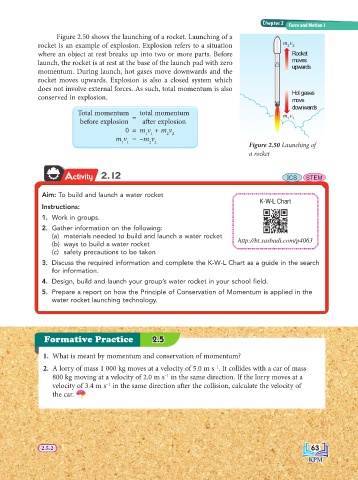
                        Figure 2.50 shows the launching of a rocket. Launching of a
                  rocket is an example of explosion. Explosion refers to a situation        m v
                                                                                             2  2
                  where an object at rest breaks up into two or more parts. Before             Rocket
                  launch, the rocket is at rest at the base of the launch pad with zero        moves
                                                                                               upwards
                  momentum. During launch, hot gases move downwards and the
                  rocket moves upwards. Explosion is also a closed system which
                  does not involve external forces. As such, total momentum is also            Hot gases
                  conserved in explosion.                                                      move
                                                                                               downwards
                              Total momentum     total momentum                             m v
                                               =
                               before explosion      after explosion                         1  1
                                            0 = m v  + m v
                                                  1 1    2 2
                                          m v  =  –m v
                                           1 1      2 2
                                                                                  Figure 2.50 Launching of
                                                                                  a rocket


                          Activity 2.12                                                      ICS   STEM

                   Aim: To build and launch a water rocket
                                                                                     K-W-L Chart
                   Instructions:
                   1.  Work in groups.
                   2.  Gather information on the following:
                      (a)  materials needed to build and launch a water rocket
                      (b)  ways to build a water rocket                       http://bt.sasbadi.com/p4063
                      (c)  safety precautions to be taken
                   3.  Discuss the required information and complete the K-W-L Chart as a guide in the search
                      for information.
                   4.  Design, build and launch your group’s water rocket in your school field.
                   5.  Prepare a report on how the Principle of Conservation of Momentum is applied in the
                      water rocket launching technology.


                    Formative Practice               2.5
                                                     2.5

                    1.  What is meant by momentum and conservation of momentum?
                    2.  A lorry of mass 1 000 kg moves at a velocity of 5.0 m s . It collides with a car of mass
                                                                       –1
                       800 kg moving at a velocity of 2.0 m s  in the same direction. If the lorry moves at a
                                                        –1
                                       –1
                       velocity of 3.4 m s  in the same direction aft er the collision, calculate the velocity of
                       the car.


                                                                                                    63
                   2.5.2
                   2.5.2                                                                            63

