


Page 128 - Computing E-Book Grade 7
P. 128
The City School  2021-2022


             1.  In the 1st line of this code, we have created a list StdMrks with four values stored

                in it.

             2.  In the 2nd line, we have declared a variable name MaxMarks with an integer value
                of 0.
             3.  In the 3rd line, we use for loop while declaring another variable i with the range of

                four.

             4.  This means this loop will run 4 times. Every time FOR loop runs, it will increase the
                value of the i variable.
             5.  In the 4th line, we have set a condition to check that if StdMrks[i] variable is

                greater than MaxMrks (declared 0 in 2nd line) variable then change the value of

                MaxMarks[i] to StdMrks value. (StdMrks[i] variable is going to change its
                value every time the loop runs and change the index of StdMrks. This process is
                also known as unary increment). Using indention is compulsory or python will not

                consider the For loop elements and give an error.

             6.  In the 5th line, MaxMrks is setting its value equal to the current value of StdMarks
                only if the condition in the previous line is true.
             7.  In the 6th line, we have just printed the value of MaxMrks along with a string

                sentence.


             5.13. Functions in Python


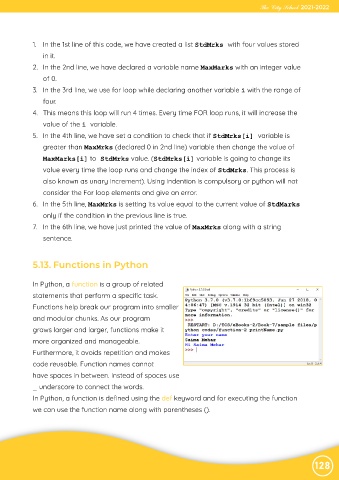
             In Python, a function is a group of related

             statements that perform a specific task.
             Functions help break our program into smaller

             and modular chunks. As our program
             grows larger and larger, functions make it

             more organized and manageable.
             Furthermore, it avoids repetition and makes

             code reusable. Function names cannot
             have spaces in between. Instead of spaces use

             _ underscore to connect the words.
             In Python, a function is defined using the def keyword and for executing the function

             we can use the function name along with parentheses ().


                                                                                                                128

