


Page 309 - King Lear: The Cambridge Dover Wilson Shakespeare
P. 309
234                 NOTES                     4.x.
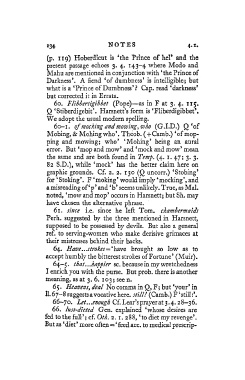
                (p. 119) Hoberdicut is 'the Prince of hel' and the
                present passage echoes 3. 4. 143-4 where Modo and
                Mahu are mentioned in conjunction with 'the Prince of
                Darkness'. A fiend 'of dumbness' is intelligible; but
                what is a 'Prince of Dumbness'? Cap. read 'darkness'
                but corrected it in Errata.
                  60. Flibbertigibbet (Pope)—as in F at 3. 4. 115.
                Q 'Stiberdigebit'. Harsnett's form is 'Fliberdigibbet'.
                We adopt the usual modern spelling.
                  60-1. of mocking andmowing, who (G.I.D.) Q 'of
                Mobing, & Mohing who'. Theob. ( + Camb.) 'of mop-
                ping and mowing; who' 'Mohing' being an aural
                error. But 'mop and mow' and 'mock and mow' mean
                the same and are both found in Temp. (4. 1. 47; 3. 3.
                82 S.D.), while 'mock' has the better claim here on
                graphic grounds. Cf. 2. 2. 130 (Q uncorr.) 'Stobing'
                for 'Stoking'. F 'moking' would imply 'mocking', and
                a misreading of'p' and' b' seems unlikely. True, as Mai.
                noted, 'mow and mop' occurs in Harsnett; but Sh. may
                have chosen the alternative phrase.
                  61. since i.e. since he left Tom. chambermaids
                Perh. suggested by the three mentioned in Harsnett,
                supposed to be possessed by devils. But also a general
                ref. to serving-women who make derisive grimaces at
                their mistresses behind their backs.
                                    l
                  64. Have...strokes= have brought so low as to
                accept humbly the bitterest strokes of Fortune' (Muir).
                  64—5. that.. .happier sc. because in my wretchedness
                I enrich you with the purse. But prob. there is another
                meaning, as at 3. 6. 103; see n.
                  65. Heavens, deal No comma in Q, F; but 'your' in
                II. 67-8 suggests a vocative here, still! (Camb.) F 'still:'.
                  66-70. Let.. .enough Cf. Lear's prayer at 3.4.2 8-36.
                  66. lust-dieted Gen. explained 'whose desires are
               fed to the full'; cf. Oth. 2. 1. 288, 'to diet my revenge'.
               But as 'diet' more often = 'feed ace. to medical prescrip-

