


Page 45 - King Lear: The Cambridge Dover Wilson Shakespeare
P. 45
xl               KIN G LEAR
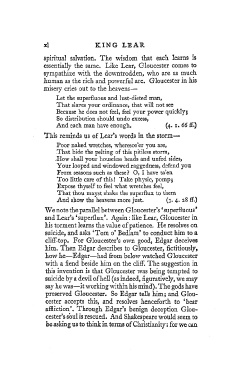
               spiritual salvation. The wisdom that each learns is
               essentially the same. Like Lear, Gloucester comes to
               sympathize with the downtrodden, who are as much
               human as the rich and powerful are. Gloucester in his
               misery cries out to the heavens—
                   Let the superfluous and lust-dieted man,
                   That slaves your ordinance, that will not see
                   Because he does not feel, feel your power quickly;
                   So distribution should undo excess,
                   And each man have enough.           (4. i. 66 ff.)
               This reminds us of Lear's words in the storm—
                   Poor naked wretches, wheresoe'er you are,
                   .That bide the pelting of this pitiless storm,
                   .How shall your houseless heads and unfed sides,
                   Your looped and windowed raggedness, defend you
                   From seasons such as these? O, I have ta'en
                   Too little care of this! Take physic, pomp;
                   Expose thyself to feel what wretches feel,
                   That thou mayst shake the superflux to them
                   And show the heavens more just.     (3. 4. 28 ff.)
               We note the parallel between Gloucester's 'superfluous'
               and Lear's 'superflux'. Again: like Lear, Gloucester in
               his torment learns the value of patience. He resolves on
                suicide, and asks 'Tom o' Bedlam' to conduct him to a
                cliff-top. For Gloucester's own good, Edgar deceives
                him. Then Edgar describes to Gloucester, fictitiously,
                how he—Edgar—had from below watched Gloucester
                with a fiend beside him on the cliff. The suggestion in
                this invention is that Gloucester was being tempted to
                suicide by a devil of hell (as indeed, figuratively, we may
                say he was—it working within his mind). The gods have
                preserved Gloucester. So Edgar tells him; and Glou-
                cester accepts this, and resolves henceforth to 'bear
                affliction'. Through Edgar's benign deception Glou-
                cester's soul is rescued. And Shakespeare would seem to
                be asking us to think in terms of Christianity: for we can

