


Page 35 - BBC Wildlife Volume 36 #02
P. 35
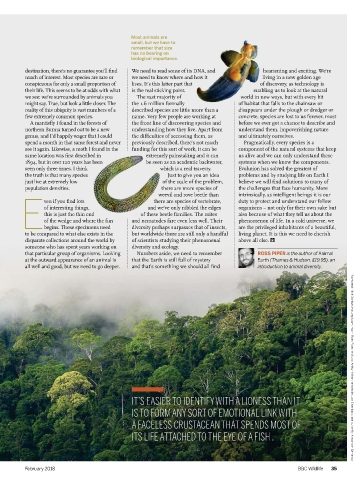
Most animals are
                                                               small, but we have to
                                                               remember that size
                                                               has no bearing on
                                                               biological importance.
                           destination, there’s no guarantee you’ll find   We need to read some of its DNA, and   heart tening and exciting. We’re
                                                                                 f
                           much of interest. Most species are rare or   we need to know where aand how it   living
                                                                                                               g in a new golden age
                                                                                  h
                                                                                                               c
                           conspicuous for only a small proportion of   lives. It’s this latter part that   of dis covery, as technology is
                                                                                                                us to look at the natural
                           their life. This seems to be at odds with what   is the real sticking point.  enabling  u
                                                                                                               w
                           we see: we’re surrounded by animals you   The vast majority of           world in new  ways, but with every bit
                           might say. True, but look a little closer. The  the 1.6 million formally   of habitat that fa alls to the chainsaw or
                           reality of this ubiquity is vast numbers of a  described species are little more than a   disappears under the plough or dredger or
                           few extremely common species.       name. Very few people are working at   concrete, species are lost to us forever, most
                             A mantisfly I found in the forests of   the front line of discovering species and   before we ever got a chance to describe and
                           northern Burma turned out to be a new   understanding how they live. Apart from  understand them, impoverishing nature
                                                                   rst
                           genus, and I’d happily wager that I could   the difficulties of accessing them, as   and ultimately ourselves.
                                                                     cu
                                                                he diffi
                           spend a month in that same forest and never   previously  d               Pragmatically, every species is a
                                                               previously described, there’s not much
                           see it again. Likewise, a moth I found in the   funding for th           component of the natural systems that keep
                                                                         this sort of work, it can be
                                                                          ly painstaking and it can
                           same location was first described in      extremely                       us alive and we can only understand these
                                                     n
                           1894, but in over 120 years has been     be seen as a an academic backwater,   systems when we know the components.
                           seen only three times. I think                which is                   Evolution has solved the greatest of
                                                                              is a real travesty.
                                                                               to give you an idea
                           the truth is that many species                   Just to                 problems and by studying life on Earth I
                                               ies
                                                                                 le
                           just live at extremely low                     of the sca ale of the problem,   believe we will find solutions to many of
                                            w
                                                                              are more species of
                           population densities.                         there are                  the challenges that face humanity. More
                                                                        weev il                     intrinsically, as intelligent beings it is our
                                                                           evil and rove beetle than
                                  ven if you find lotlots               th e                         duty to protect and understand our fellow
                                                                       here are species of vertebrate,
                                                                       d
                                  of interesting thingngs,           and we’ve only nibbled the edges   organisms – not only for their own sake but
                                                                     an
                                  this is just the thin enend     of                                also because of what they tell us about the
                                                                  of these beetle families. The mites
                                  of the wedge and whereere the fun  an                             phenomenon of life. In a cold universe, we
                                                               and nematodes fare even less well. Their
                          Ebegins. These specimens ns need     diversity perhaps surpasses that of insects,   are the privileged inhabitants of a beautiful,
                                                                                                    li ing planet. It is this we need to cherish
                                          h t l
                                                  it iithin the
                                      d t
                           to be compared to what else exists in  b u t  ld id th  till  l  h  df l  li v i  l  tIt i thi  d t  h i h
                           t b
                                                               b t worldwide there are still only a handful
                           disparate collections around the world by   of scientists studying their phenomenal   above all else.
                                                        b
                                                       d
                           someone who has spent years working on   diversity and ecology.
                           that particular group of organisms. Looking   Numbers aside, we need to remember   ROSS PIPER is the author of Animal
                           at the outward appearance of an animal is  that the Earth is still full of mystery   Earth (Thames & Hudson, £19.95), an
                           all well and good, but we need to go deeper.   and that’s something we should all find   introduction to animal diversity.


                                                               IT’S EASIER TO IDENTIFY WITH A LIONESS THAN IT                             Rainforest: Nick Garbutt/naturepl.com; moth: Ross Piper; mollusc: Arthur Anker; nematode: Jon Eisenback; sea butterfly: Alexander Semenov
                                                               IS TO FORM ANY SORT OF EMOTIONAL LINK WITH

                                                               A FACELESS CRUSTACEAN THAT SPENDS MOST OF
                                                               ITS LIFE ATTACHED TO THE EYE OF A FISH .


                           February 2018                                                                                BBC Wildlife  35

