


Page 34 - BBC Wildlife Volume 36 #02
P. 34
talkin g

                                                                        POINT


                                                                            out what’s what. In part   ones. Only by delving into natural history
                           Calleremites
                                                                          th
                                     only
                           subornata has only                             this is linked to the common   and DNA can we reveal the true extent of
                                                                         conception of how evolution
                                    ee times
                           been seen three times                       preco                        cryptic diversity. This is a burgeoning area of
                                   first
                           since it was first                       works. To o many people, evolution is  research in all fields of zoology. A beautiful

                                    18
                           described in 1894.   .                a one-way, l linear process where simple   example of how much diversity
                                     94
                                                               forms give ri ise to increasingly complex ones,  is hiding in plain sight is a
                                                                                                                   C
                           As parasitologist Bob Kabata, once said, once said:    so it has bec come ingrained that simple forms  parasitoid wasp from Costa
                                                                                                                    osta
                                                               must be primitive. In reality, evolution just as
                                                                                                                    to
                           “Had the copepod [a small crustacean]   must be pri                      Rica that was assumed to be
                                                                    m
                           been the size of a cow, the tip of its first   easily moves in the other direction.  one species. Entomologiststs
                                                                     ov
                           antenna would have become a topic for   In adapting to a particular niche, an animal  looked at its DNA and
                           exhaustive studies.”                can progressively lose many (sometimes  ecology – exactly where
                             Getting to grips with animal diversity is   all) of its complex features. These so-called  and how it lives – to reveal
                           further confounded by the fact that we’re   degenerates – charming characters such  it is actually a complex of 36
                           drawn to species with which we feel an  as tongue worms, slime animals and  outwardly identical species,
                           emotional attachment. Typically, these are   thorny-headed worms – had generations of   all living distinct lives.
                           mammals with cute wet noses, doe eyes and   zoologists scratching their heads. It was only   Tropical forests and coral reefs are
                                                                                                                           fs are
                           so on. However, many animals are faceless;   the ability to sequence DNA that revealed   where we find the greatest concentrations
                                                                                                                             t
                                                                                                                           en
                           lots don’t even have a head. The appearances   their true heritage.      of life, but going to these places and
                           and lifestyles of most animals are very alien                            documenting their fauna in a systematic
                           indeed. It’s easier to identify with a lioness  eaped on top of this secondary   way is often difficult. For me, the canopy of
                           and the challenges she faces nurturing her   simplification – to make things   a primary tropical forest is most tantalising
                           cubs than it is to form any sort of emotional   even more complicated – nature   of all – it’s there within easy reach, yet
                           link with a faceless crustacean that spends  can trick us at every turn with a   exploring it freely without disturbing it
                           most of its life attached to the eye of a fish.  H huge variety of doppelgangers and  excessively is next to impossible. Some
                             The often very strange outward appearance   deceivers. Many animals look very similar  regions are out of bounds because of war
                                                                   though they aren’t closely related, either
                                                                                                     d political strife, while others are just
                                  l
                               i
                            f of animals also impedes our attempts to work   even th  h th  ’t l  l  l t d ith  and  liti l tif  hil  th  jt
                                                 tt
                                    l
                                       i
                                          d
                                                           k
                                                     t t
                                                               because they happen to live in similar ways or  extremely remote and hostile once you’ve
                                                               because there’s some mimicry going on.  managed to get there. And exploring the
                                                                 There’s also a huge amount of cryptic  deep sea is as challenging as going into
                                                               diversity, where something that looks like one  space, with a similarly hefty price tag.
                                                               species is actually several identical-looking  Even if you manage to reach your


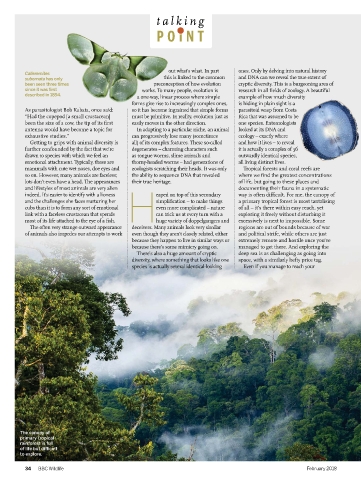
                          The canopy of
                          primary tropical
                          rainforest is full
                          of life but difficult
                          to explore.

                           34   BBC Wildlife                                                                               February 2018

