


Page 33 - BBC Wildlife Volume 36 #02
P. 33
t alkin g

                                                                        POINT


                                                  THE SPICE


                                                           OF LIFE


                             New research suggests we could share Earth with six billion other species. Entomologist
                                  Ross Piper asks if we have radically underestimated our planet’s biodiversity.


                                      illionaire technologists and   bacteria (approximately 70–90 per cent of   Mercator projection shows Greenland and
                                      futurists who have read   species) and insects are only one of many   Africa roughly equal in size, but Africa is
                                      too many comics fuel the   hyperdiverse groups.” This whopping   actually 15 times larger and, like everywhere
                                      human ego with visions   estimate embraces the enormous bacterial   else, has many overlooked areas where few
                                      of interstellar travel and   diversity we find wherever we look, not to   biologists have ever been.
                                      terraforming the cold, dead   mention parasites and the hyper-diversity   Changing scale, now think about the
                         B dust of Mars. Theirs is a           of insects, mites and nematodes. Animals   structural complexity of a forest – the
                           jaded view of the Earth, a planet that has   account for 163 million species.  waterbodies, soil, roots, detritus, stems,
                           nothing left to offer, from which all the   There are plenty of reasons why the   boughs, leaves, bark and seeds. The variety
                           mystery has been wrung. Nothing could   University of Arizona estimate is nearer   of niches in a forest is mind-boggling.
                           be further from the truth. We have barely   the mark. For starters, Earth is big. We   Some of my work in Peru involves getting a
                           scratched the surface of understanding   tend to forget just how big. Not only that,   handle on this – exploring the extraordinary
                           our beautiful world, including how many   but popular maps of our planet stretch   diversity of animals that live in the
                           species we share it with.           and distort, so that the landmasses are   unfurling leaves of a couple of species of
                             To date we have formally described  not shown as they really are. The standard   understorey plants.
                           around 1.6 million species of living things,
                           broadly divided between three domains:                                            ceans are a huge unknown, as
                           bacteria; archaea (single-celled microbes                                         BBC One’s Blue Planet II recently
                                                                                                                              I
                           distinct from bacteria); and eukaryotes   WE HAVE  BARELY                         showed to dramatic effect, but
                           (animals, plants, fungi and protists                                              even there we underestimate.
                           like slime molds). How many more are       SCRATCHED THE                OIt’s often said that we’ve explored
                           there? This question is one of the most                                  around five per cent of the ocean, yet this
                           fundamental in science, but answering it      SURFACE OF                 refers to the seabed and anyway is probably
                           is far from straightforward. The closer we                               an exaggeration. In fact, the whole volume of
                         Main illustration by Patrick George/Debut Art; sediment illustartion by Phil Miller
                           look at life on Earth, the more confusing   UNDERSTANDING OUR            the ocean is a habitat, and we’ve explored less
                           it becomes. Under scrutiny, even the term                                than one per cent of it.
                           ‘species’ is a bit flaky.                 BEAUTIFUL WORLD.                 Not only is Earth enormous, but most
                             Regardless, answering this question has                                animals are small. Take the constellation
                           become something of a cottage industry in                                of sub-1mm animals that live between and
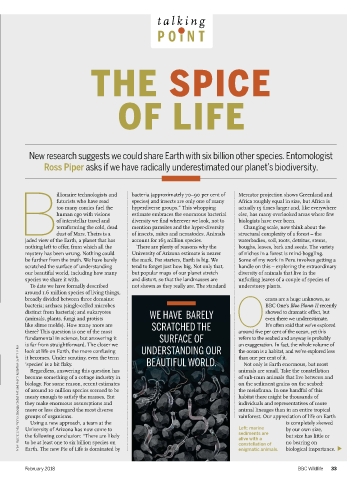
                           biology. For some reason, recent estimates                               on the sediment grains on the seabed:
                           of around 10 million species seemed to be                                the meiofauna. In one handful of this
                           meaty enough to satisfy the masses. But                                  habitat there might be thousands of
                           they make enormous assumptions and                                       individuals and representatives of more
                           more or less disregard the most diverse                                  animal lineages than in an entire tropical
                           groups of organisms.                                                     rainforest. Our appreciation of life on Earth
                             Using a new approach, a team at the                                                    is completely skewed
                           University of Arizona has now come to                                    Left: marine    by our own size,
                                                                                                    sediments are
                           the following conclusion: “There are likely                                              but size has little or
                                                                                                    alive with a
                           to be at least one to six billion species on                             constellation of   no bearing on
                           Earth. The new Pie of Life is dominated by                               enigmatic animals.  biological importance.

                           February 2018                                                                                BBC Wildlife  33

