


Page 265 - (DK Eyewitness) Travel Guide - Morocco
P. 265
HIGH A TLAS 263
Berbers of the High Atlas
The Berbers of the High Atlas are non-nomadic peasants. Many of them have a
completely self-sufficient lifestyle, and in certain valleys mule tracks are the only channel
of communication with the outside world. The inhabitants of these remote valleys live by
the pattern of the seasons and the round of work in the fields. In the autumn, the men till
the soil with a wooden plough and buy and sell goods and produce at the weekly souk.
In winter, the women collect water from the river, gather wood and weave thick woollen
blankets. In spring, the men dig and maintain vital irrigation channels. In summer, the
women harvest and thresh the grain, while the men winnow barley on threshing floors.
Family Festivals
The daily life of the Berber
women of the High Atlas is
enlivened by family festivals.
The women, dressed in dazzling
clothes, dance the ahwach or
the ahidous, according to the
region, while the men intone
chants as they beat out a regular
rhythm on their bendir.
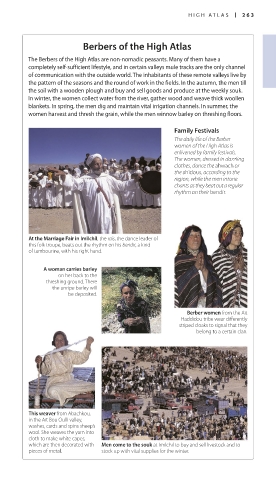
At the Marriage Fair in Imilchil, the raïs, the dance leader of
this folk troupe, beats out the rhythm on his bendir, a kind
of tambourine, with his right hand.
A woman carries barley
on her back to the
threshing ground. There
the unripe barley will
be deposited.
Berber women from the Aït
Haddidou tribe wear differently
striped cloaks to signal that they
belong to a certain clan.
This weaver from Abachkou,
in the Aït Bou Oulli valley,
washes, cards and spins sheep’s
wool. She weaves the yarn into
cloth to make white capes,
which are then decorated with Men come to the souk at Imilchil to buy and sell livestock and to
pieces of metal. stock up with vital supplies for the winter.
For hotels and restaurants see p312 and pp328–9
262-263_EW_Morocco.indd 263 09/08/16 11:20 am

