


Page 295 - (DK Eyewitness) Travel Guide - Morocco
P. 295
SOUTHERN MOROC C O & WESTERN SAHAR A 293
be seen walking around the
well-watered gardens, except
when the Thursday souk is on.
Some 30 ksour stand in the
great Tata Palm Grove, where
Berber and Arabic are spoken.
Crossing Wadi Tata, which
irrigates the grove, the road
leads to Agadir-Lehne, where
a stone koubba stands below a
spring. Some 4 km (2.5 miles)
further on are the Messalite
caves, which are inhabited
sporadically by shepherds.
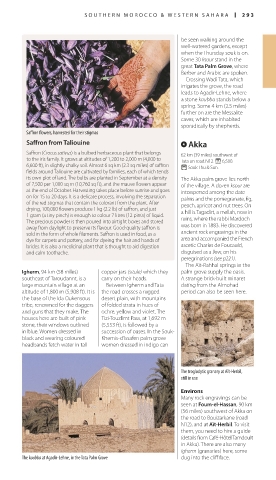
Saffron flowers, harvested for their stigmas
Saffron from Taliouine 4 Akka
Saffron (Crocus sativus) is a bulbed herbaceous plant that belongs 62 km (39 miles) southwest of
to the iris family. It grows at altitudes of 1,200 to 2,000 m (4,000 to Tata on road N12. * 6,500.
6,600 ft), in slightly chalky soil. Almost 6 sq km (2.3 sq miles) of saffron ( Souk Thu & Sun.
fields around Taliouine are cultivated by families, each of which tends
its own plot of land. The bulbs are planted in September at a density The Akka palm grove lies north
of 7,500 per 1,000 sq m (10,760 sq ft), and the mauve flowers appear of the village. A dozen ksour are
at the end of October. Harvesting takes place before sunrise and goes interspersed among the date
on for 15 to 20 days. It is a delicate process, involving the separation palms and the pomegranate, fig,
of the red stigmas that contain the colorant from the plant. After peach, apricot and nut trees. On
drying, 100,000 flowers produce 1 kg (2.2 lb) of saffron, and just a hill is Tagadirt, a mellah, now in
1 gram (a tiny pinch) is enough to colour 7 litres (12 pints) of liquid.
The precious powder is then poured into airtight boxes and stored ruins, where the rabbi Mardoch
away from daylight to preserve its flavour. Good-quality saffron is was born in 1883. He discovered
sold in the form of whole filaments. Saffron is used in food, as a ancient rock engravings in the
dye for carpets and pottery, and for dyeing the hair and hands of area and accompanied the French
brides. It is also a medicinal plant that is thought to aid digestion ascetic Charles de Foucauld,
and calm toothache. disguised as a Jew, on his
peregrinations (see p221).
The Aït-Rahhal springs in the
Igherm, 94 km (58 miles) copper jars (situle) which they palm grove supply the oasis.
southeast of Taroudannt, is a carry on their heads. A strange brick-built minaret
large mountain village at an Between Igherm and Tata dating from the Almohad
altitude of 1,800 m (5,908 ft). It is the road crosses a rugged period can also be seen here.
the base of the Ida Oukensous desert plain, with mountains
tribe, renowned for the daggers of folded strata in hues of
and guns that they make. The ochre, yellow and violet. The
houses here are built of pink Tizi-Touzlimt Pass, at 1,692 m
stone, their windows outlined (5,553 ft), is followed by a
in blue. Women dressed in succession of oases. In the Souk-
black and wearing coloured Khemis-d’Issafen palm grove
headbands fetch water in tall women dressed in indigo can
The troglodytic granary at Aït-Herbil,
still in use
Environs
Many rock engravings can be
seen at Foum-el-Hassan, 90 km
(56 miles) southwest of Akka on
the road to Bouizarkane (road
N12), and at Aït-Herbil. To visit
them, you need to hire a guide
(details from Café-Hôtel Tamdoult
in Akka). There are also many
igherm (granaries) here, some
The koubba at Agadir-Lehne, in the Tata Palm Grove dug into the cliff face.
292-293_EW_Morocco.indd 293 09/08/16 11:20 am

