


Page 94 - 100% Biker (January 2020)
P. 94
SHED HEAD


            Fig.4                                                                     Fig.5


            Fig.6                                                                      Fig.7
                           THERE ARE TWO THINGS YOU NEED TO KNOW TO MAKE A SIMPLE BEND; WHERE

                              TO PLACE THE TUBE IN THE BENDER AND WHAT ANGLE TO BEND IT THROUGH


            mount got a bit of an on-the-fly redesign and was cut out of              There are basically two things you need to know to make
            some ¼-inch plate instead of the 1 x 3/16-inch strap that the           a simple bend; where to place the tube in the bender and
            drawing specifies. The difference in material thickness might           what angle to bend it through. The first point to note here is
            mean a small alteration later.                                          the ‘where to place the tube in the bender’ isn’t going to be
              While I’m still struggling with whether or not to build               where the bend starts, hence the existence of the test bend.
            the frame on my frame jig, either way the top tube and the              The test bend is made by cutting about a foot of the exact type
            seat rails are best built on a flat surface marked out with             of tube that you’re going to be bending and then marking it
            the required dimensions. This is where a drawing is pretty              with a reference point that lines up with the bender and can
            handy as it has all the dimensions you need to lay the top of           be easily seen. In most cases this is going to be the start of the
            the frame out. So, with the top of the bench covered in some            former for radial benders or, for push through benders, the
            masking paper, I drew out a centre line for the top tube and            centre of the former.
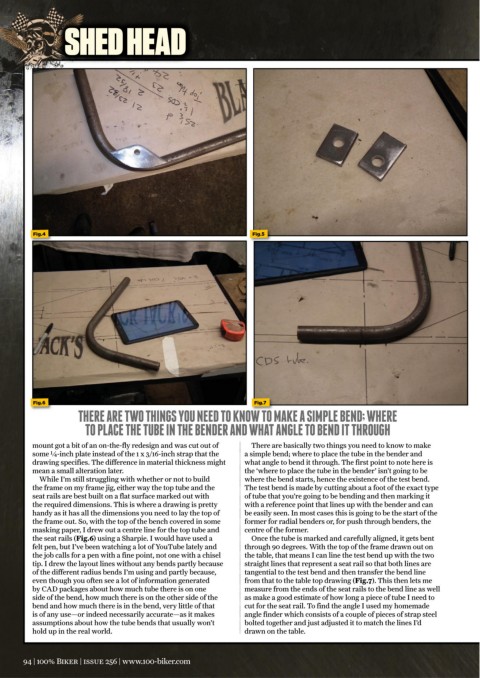
            the seat rails (Fig.6) using a Sharpie. I would have used a               Once the tube is marked and carefully aligned, it gets bent
            felt pen, but I’ve been watching a lot of YouTube lately and            through 90 degrees. With the top of the frame drawn out on
            the job calls for a pen with a fine point, not one with a chisel        the table, that means I can line the test bend up with the two
            tip. I drew the layout lines without any bends partly because           straight lines that represent a seat rail so that both lines are
            of the different radius bends I’m using and partly because,             tangential to the test bend and then transfer the bend line
            even though you often see a lot of information generated                from that to the table top drawing (Fig.7). This then lets me
            by CAD packages about how much tube there is on one                     measure from the ends of the seat rails to the bend line as well
            side of the bend, how much there is on the other side of the            as make a good estimate of how long a piece of tube I need to
            bend and how much there is in the bend, very little of that             cut for the seat rail. To find the angle I used my homemade
            is of any use—or indeed necessarily accurate—as it makes                angle finder which consists of a couple of pieces of strap steel
            assumptions about how the tube bends that usually won’t                 bolted together and just adjusted it to match the lines I’d
            hold up in the real world.                                              drawn on the table.


         94 | 100% Biker | issue 256 | www.100-biker.com

