


Page 42 - All About History - Issue 186-19
P. 42
EYE ISSUES


                                                                           Medieval Diagnosis: Cataracts

                                                                           Recommended Treatment: Needles


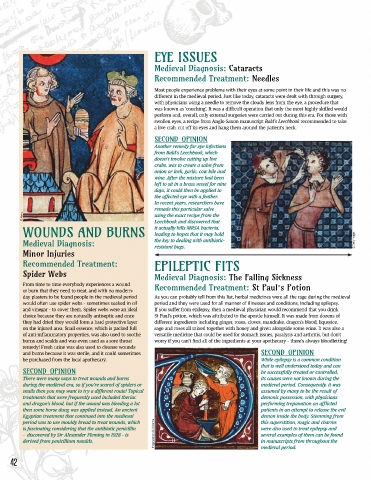
                                                                           Most people experience problems with their eyes at some point in their life and this was no
                                                                           different in the medieval period. Just like today, cataracts were dealt with through surgery,
                                                                           with physicians using a needle to remove the cloudy lens from the eye, a procedure that
                                                                           was known as ‘couching’. It was a difficult operation that only the most highly skilled would
                                                                           perform and, overall, only external surgeries were carried out during this era. For those with
                                                                           swollen eyes, a recipe from Anglo-Saxon manuscript Bald’s Leechbook recommended to take
                                                                           a live crab, cut off its eyes and hang them around the patient’s neck.
                                                                           SECOND OPINION

                                                                           Another remedy for eye infections
                                                                           from Bald’s Leechbook, which
                                                                           doesn’t involve cutting up live
                                                                           crabs, was to create a salve from
                                                                           onion or leek, garlic, cow bile and
                                                                           wine. After the mixture had been
                                                                           left to sit in a brass vessel for nine
                                                                           days, it could then be applied to
                                                                           the affected eye with a feather.
                                                                           In recent years, researchers have
                                                                           remade this particular salve
            © Alamy                                                        using the exact recipe from the

                                                                           Leechbook and discovered that
            WOUNDS AND BURNS                                               it actually kills MRSA bacteria,

                                                                           leading to hopes that it may hold
            Medieval Diagnosis:                                            the key to dealing with antibiotic-                                                             © Getty Images
                                                                           resistant bugs.
            Minor Injuries

            Recommended Treatment:                                         EPILEPTIC FITS

            Spider Webs                                                    Medieval Diagnosis: The Falling Sickness


            From time to time everybody experiences a wound                Recommended Treatment: St Paul’s Potion
            or burn that they need to treat, and with no modern-
            day plasters to be found people in the medieval period         As you can probably tell from this list, herbal medicines were all the rage during the medieval
            would often use spider webs – sometimes soaked in oil          period and they were used for all manner of illnesses and conditions, including epilepsy.
            and vinegar – to cover them. Spider webs were an ideal         If you suffer from epilepsy, then a medieval physician would recommend that you drink
            choice because they are naturally antiseptic and once          St Paul’s potion, which was attributed to the apostle himself. It was made from dozens of
            they had dried they would form a hard protective layer         different ingredients including ginger, roses, cloves, mandrake, dragon’s blood, liquorice,
            on the injured area. Snail essence, which is packed full       sage and roses all mixed together with honey and given alongside some wine. It was also a
            of anti-inflammatory properties, was also used to soothe       versatile medicine that could be used for stomach issues, paralysis and arthritis, but don’t
            burns and scalds and was even used as a sore throat            worry if you can’t find all of the ingredients at your apothecary – there’s always bloodletting!
            remedy! Fresh urine was also used to cleanse wounds
            and burns because it was sterile, and it could sometimes                                                          SECOND OPINION
            be purchased from the local apothecary.                                                                           While epilepsy is a common condition
                                                                                                                              that is well understood today and can
            SECOND OPINION                                                                                                    be successfully treated or controlled,

            There were many ways to treat wounds and burns                                                                    its causes were not known during the
            during the medieval era, so if you’re scared of spiders or                                                        medieval period. Consequently, it was
            snails then you may want to try a different route! Topical                                                        assumed by many to be the result of
            treatments that were frequently used included theriac                                                             demonic possession, with physicians
            and dragon’s blood, but if the wound was bleeding a lot                                                           performing trepanation on afflicted
            then some horse dung was applied instead. An ancient                                                              patients in an attempt to release the evil
            Egyptian treatment that continued into the medieval                                                               demon inside the body. Stemming from
            period was to use mouldy bread to treat wounds, which                                                             this superstition, magic and charms
            is fascinating considering that the antibiotic penicillin                                                         were also used to treat epilepsy and
            – discovered by Sir Alexander Fleming in 1928 – is             Image source: wiki/Avicenna                        several examples of them can be found
            derived from penicillium moulds.                                                                                  in manuscripts from throughout the
                                                                                                                              medieval period.

      42

