


Page 78 - All About History - Issue 186-19
P. 78
Greatest Battles


                                                                                 La              he    my to victory   days, the Muslim advance guard had captured
                                                                                                 el    oe at Antioch   the outerworks, including the Tower of the Iron
                                                                                                                       Bridge, and invested the city. Small detachments
                                                                                                                       of Seljuk foot soldiers took up positions outside
                                                                                                                       the city’s main gates. “[The] Turks hemmed in
                                                                                                                       our
                                                                                                                       Fren                                             d
                                                                                                                       the
                                                                                                                         Af
                                                                                                                       reinf
                                                                                                                       esta
                                                                                                                       and western w
                                                                                                                       relief army’s i
                                                                                                                       failed, time w
                                                                                                                       were at a disti
                                                                                                                       lacked sufficie
                                                                                                                       Morale was lo
                                                                                                                       over the walls and made their way to the port of
                                                                                                                       St Symeon at the mouth of the Orontes in the hope
                                                                                                                       of      g
                                                                                                                               ri                g      r
                                                                                                                       m      re                 t       o          er
                                                                                                                       B                        pi      c
          merchants who were hoarding grain give up half        ranks. Ironically, Kerbogha’s army arrived on the      have received divine instruction from God of the
          of their supply to the garrison commander. This       plain outside the city on 4 June, the day after the    existence of the Holy Lance — the point of which
          rankled the wealthy merchants.                        crusaders had secured the city. He established his     had pierced Christ’s body while he was on the
             An Armenian officer and merchant named Firouz,     main camp three miles north of the city in the         cross — telling him that it was buried beneath the
          a convert to Islam, believed that the edict threatened  Orontes Valley.                                      Cathedral of St. Peter. Bartholomew and some other
          his family’s livelihood. He turned over half of his      Kerbogha’s first order of business was to capture   volunteers excavated the floor of the cathedral in
          grain begrudgingly. As an officer of the garrison,    the crusader outposts outside the city. After three    search of the relic.
          Firouz was responsible for guarding a section of
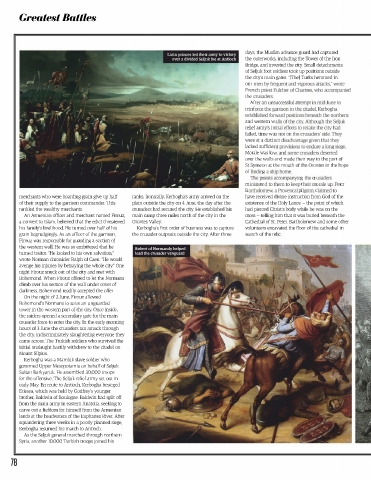
          the western wall. He was so embittered that he          Robert of Normandy helped
          turned traitor. “He looked to his own salvation,”       lead the crusader vanguard
          wrote Norman chronicler Ralph of Caen. “He would
          avenge his injuries by betraying the whole city.” One
          night Firouz snuck out of the city and met with
          Bohemond. When Firouz offered to let the Normans
          climb over his section of the wall under cover of
          darkness, Bohemond readily accepted the offer.
             On the night of 2 June, Firouz allowed
          Bohemond’s Normans to seize an unguarded
          tower in the western part of the city. Once inside,
          the raiders opened a secondary gate for the main
          crusader force to enter the city. In the early morning
          hours of 3 June the crusaders ran amuck through
          the city, indiscriminately slaughtering everyone they
          came across. The Turkish soldiers who survived the
          initial onslaught hastily withdrew to the citadel on
          Mount Silpius.
             Kerbogha was a Mamluk slave soldier who
          governed Upper Mesopotamia on behalf of Seljuk
          Sultan Barkyaruk. He assembled 30,000 troops
          for the offensive. The Seljuk relief army set out in
          early May. En route to Antioch, Kerbogha besieged
          Edessa, which was held by Godfrey’s younger
          brother, Baldwin of Boulogne. Baldwin had split off
          from the main army in eastern Anatolia, seeking to
          carve out a fiefdom for himself from the Armenian
          lands at the headwaters of the Euphrates River. After
          squandering three weeks in a poorly planned siege,
          Kerbogha resumed his march to Antioch.
             As the Seljuk general marched through northern
          Syria, another 10,000 Turkish troops joined his


      78

