


Page 55 - History of War - Issue 10-14
P. 55
THE BOXER REBELLION


            disabling the railroad through the countryside to
            isolate Beijing.
              There were other problems in Beijing,
            however. Chinese Muslim soldiers, acting
            independently to the Boxers, had taken to
            guarding the southern part of Beijing’s walled
            city and on 11 June, 1900, they murdered a
            Japanese diplomat. On the same day, came
            the incident that would set the rebellion in
            motion – after the fi rst Boxer was seen in
            Beijing’s Legation Quarter, sparking panic
            amongst the foreign missionaries and
            diplomats, the German Minister Clemens
            von Ketteler and his soldiers captured and
            executed a Boxer boy. After six decades of
            foreign powers overpowering and governing
            them, this was a relatively small incident, but
            one that was ultimately met with an inevitable
            and violent uprising.
              To avenge the boy, thousands of Boxers
            charged the city, burning churches with
            Christians still inside. A further 2,000 European
            troops, under command of British Vice-Admiral
            Edward Seymour, were sent to Tianjin to quell the
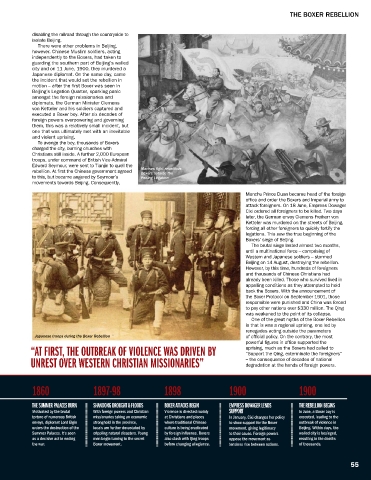
                                                   Marines fi ght rebellious
            rebellion. At fi rst the Chinese government agreed
                                                   Boxers outside the
            to this, but became angered by Seymour’s   Peking Legation
            movements towards Beijing. Consequently,
                                                                                       Manchu Prince Duan became head of the foreign
                                                                                       offi ce and order the Boxers and Imperial army to
                                                                                       attack foreigners. On 18 June, Empress Dowager
                                                                                       Cixi ordered all foreigners to be killed. Two days
                                                                                       later, the German envoy Clemens Freiherr von
                                                                                       Ketteler was murdered on the streets of Beijing,
                                                                                       forcing all other foreigners to quickly fortify the
                                                                                       legations. This saw the true beginning of the
                                                                                       Boxers’ siege of Beijing.
                                                                                         The brutal siege lasted almost two months,
                                                                                       until a multinational force – comprising of
                                                                                       Western and Japanese soldiers – stormed
                                                                                       Beijing on 14 August, destroying the rebellion.
                                                                                       However, by this time, hundreds of foreigners
                                                                                       and thousands of Chinese Christians had
                                                                                       already been killed. Those who survived lived in
                                                                                       appalling conditions as they attempted to hold
                                                                                       back the Boxers. With the announcement of
                                                                                       the Boxer Protocol on September 1901, those
                                                                                       responsible were punished and China was forced
                                                                                       to pay other nations over $330 million. The Qing
                                                                                       was weakened to the point of its collapse.
                                                                                         One of the great myths of the Boxer Rebellion
                                                                                       is that is was a regional uprising, one led by
                                                                                       renegades acting outside the parameters
             Japanese troops during the Boxer Rebellion                                of offi cial policy. On the contrary, the most
                                                                                       powerful fi gures in offi ce supported the
            “AT FIRST, THE OUTBREAK OF VIOLENCE WAS DRIVEN BY                          uprising, much as the Boxers had called to
                                                                                       “Support the Qing, exterminate the foreigners”
            UNREST OVER WESTERN CHRISTIAN MISSIONARIES”                                – the consequence of decades of national
                                                                                       degradation at the hands of foreign powers.


            1860                  1897-98                  1898                   1900                    1900


            THE SUMMER PALACES BURN  SHANDONG DROUGHT & FLOODS  BOXER ATTACKS BEGIN  EMPRESS DOWAGER LENDS   THE REBELLION BEGINS
            Motivated by the brutal   With foreign powers and Christian   Violence is directed mainly   SUPPORT  In June, a Boxer boy is
            torture of numerous British   missionaries taking an economic   at Christians and places   In January, Cixi changes her policy   executed, leading to the
            envoys, diplomat Lord Elgin   stronghold in the province,   where traditional Chinese   to show support for the Boxer   outbreak of violence in
            orders the destruction of the   locals are further devastated by   culture is being eradicated   movement, giving legitimacy   Beijing. Within days, the
            Summer Palaces. It’s seen   crippling natural disasters. Young   by foreign infl uence. Boxers   to their cause. Foreign powers   walled city is besieged,
            as a decisive act in ending   men begin turning to the secret   also clash with Qing troops   oppose the movement as   resulting in the deaths
            the war.              Boxer movement.          before changing allegiance.  tensions rise between nations.  of thousands.


                                                                                                                            55

