


Page 60 - History of War - Issue 10-14
P. 60
THE ROMAN WAR MACHINE


         FORMATION


         &TACTICS

          The Roman battle line was unlike
          anything seen before and was ideal
          to deal with nearly any scenario

          A professional and conscripted force, the Roman military
          introduced many new and innovative features of warfare. Prior
          to the Empire, the phalanx was the dominant tactic on ancient
          battlefi elds but the Romans successfully made this once great
          formation obsolete in a matter of decades.

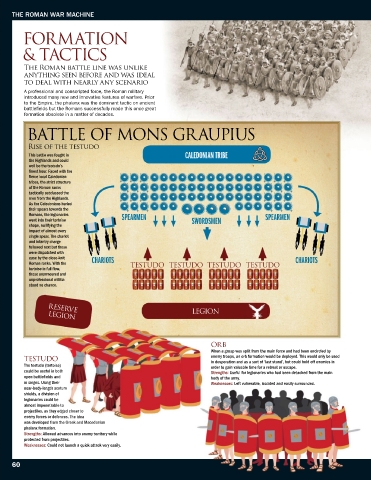
          BATTLE OF MONS GRAUPIUS


           Rise of the testudo
                                                                  CALEDONIAN TRIBE
           This battle was fought in
           the Highlands and could
           well be the testudo’s
           fi nest hour. Faced with the
           fi erce local Caledonian
           tribes, the strict structure
           of the Roman ranks
           tactically outclassed the
           men from the Highlands.
           As the Caledonians hurled
           their spears towards the
           Romans, the legionaries          SPEARMEN                                          SPEARMEN
           went into their tortoise                                 SWORDSMEN
           shape, nullifying the
           impact of almost every
           single spear. The chariot
           and infantry charge
           followed next but these
           were dispatched with
           ease by the close-knit   CHARIOTS                                                             CHARIOTS
           Roman ranks. With the               TESTUDO TESTUDO TESTUDO TESTUDO
           tortoise in full fl ow,
           these unarmoured and
           unprofessional militia
           stood no chance.


                  RESERVE
                                                                    LEGION
                  LEGION


                                                                           ORB
                                                                           When a group was split from the main force and had been encircled by
          TESTUDO                                                          enemy troops, an orb formation would be deployed. This would only be used
                                                                           in desperation and as a sort of ‘last stand’, but could hold off enemies in
          The testudo (torto
                                                                           order to gain valuable time for a retreat or escape.
          could be useful in
                                                                           Strengths: Useful for legionaries who had been detached from the main
          open battlefi elds a                                             body of the army.
          in sieges. Using th                                              Weaknesses: Left vulnerable isolated and easily surrounded
          near-body-length s
          shields, a division
          legionaries could b
          almost impenetrab
          projectiles, as they
          enemy forces or de
          was developed fro
          phalanx formation.
          Strengths: Allowed advances into enemy territory while
          protected from projectiles.
          Weaknesses: Could not launch a quick attack very easily.


     60

