


Page 58 - History of War - Issue 10-14
P. 58
THE ROMAN WAR MACHINE


             TRAINING                             be decreased when the Empire was at war.
                                                  Afterswearinganoathofallegiancecalleda
                                                  ‘sacrementum’ to the emperor, he would begin  TRAINING ARENAS
             HowtheRomanarmywas                   his training. A huge emphasis was placed on  In harsh winters, training
             putthroughitspacesasit               marchingandlegionswouldtravel20Roman        would be moved indoors
             prepared for battle                  miles(18.4miles/29.6km)aday,withafull       to purpose-built arenas
                                                  load of equipment on their backs. There would  within the camps, so drills
             To be selected, a recruit legionary would have  also be repeated practise of formations and  could be carried out 365
             to be at least 1.8 metres (5ft 10 inches) tall,  strategies to use in battles. Weapons training  days of the year whatever
             be physically fit and have good eyesight. He  wasadailyexerciseaswastheconstructionof  the weather.
             wouldusuallybeallowedtobeginhismilitary  ramparts and fortifications in case of a surprise
             trainingattheageof18,althoughthiscould  barbarianambushonaRomancamp.


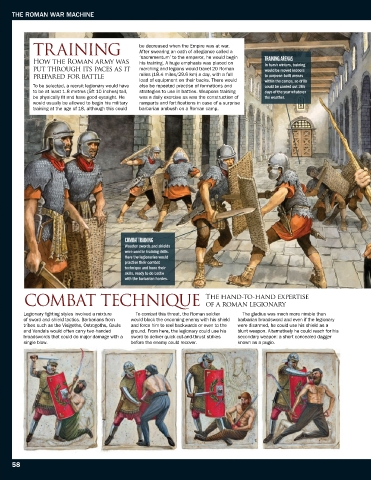
                                             COMBAT TRAINING
                                             Wooden swords and shields
                                             were used in training drills.
                                             Here the legionaries would
                                             practise their combat
                                             technique and hone their
                                             skills, ready to do battle
                                             with the barbarian hordes.

                                                                         The hand-to-hand expertise
          COMBAT TECHNIQUE ofaromanlegionary
         Legionary fighting styles involved a mixture  To combat this threat, the Roman soldier  The gladius was much more nimble than
         ofswordandshieldtactics.Barbariansfrom  would block the oncoming enemy with his shield  barbarian broadsword and even if the legionary
         tribes such as the Visigoths, Ostrogoths, Gauls  andforcehimtoreelbackwardsoreventothe  were disarmed, he could use his shield as a
         and Vandals would often carry two-handed  ground. From here, the legionary could use his  blunt weapon. Alternatively he could reach for his
         broadswords that could do major damage with a  sword to deliver quick cut-and-thrust strikes  secondary weapon: a short concealed dagger
         single blow.                          before the enemy could recover.       knownasapugio.


     58

