


Page 260 - (DK Eyewitness) Travel Guide - Germany
P. 260
258 SOUTHERN GERM AN Y BA V ARIA 259
9 Berching Amberg was once the residential The finest example of these is The St Salvator’s residence is situated in
town of the Rhine palatines, the Deutsches Haus, which Church features the northeastern part
Map D6. * 7,500. n Petten-
koferplatz 12 (08462-205 13). whose Renaissance palace and stands opposite St George’s original Gothic of the Old Town.
chancellery have survived to the Church. Dating from the late altars and a portal Remodelled several times
This charming little town, present day. 15th to the early 16th century, that has the it is now a Baroque Neo-
situated in the valley of the river The symbol of Amberg is the the house once belonged to scene of the Last Classical structure. Its 27
Sulz, boasts a history that Stadtbrille, the bridge spanning the Drechsel-Deufstetten family Judgement in original state apartments
stretches back to the 9th century. the river Vils, whose arches and is now a hotel-restaurant. the tympanum. include the Mirror Room,
To this day it retains the complete reflected in the river resemble The late-Gothic Church of St The former hospital Mirror Gallery, Dining
enclosure of its medieval city a pair of glasses – hence its George is a triple-nave hall- of the Holy Spirit is Room and Audience
walls, including towers and nickname “the town’s spectacles”. church with no transept. now home to an Room. It now houses the
gates with old oak doors. The Together with the presbytery, interesting Stadt Museum of Faience and Majestic Walhalla near Donaustauf
most beautiful of the towers is it forms one large interior museum. The Porcelain. The nearby
the Chinesische Turm (the crowned with magnificent 14th-century Hofgarten has a 102-m (335-ft) Altmühl, stands the picturesque
Chinese Tower). network vaults. The most town hall long Orangery. It also houses a Willibald Castle, which until the
The regional museum is well valuable items of the interior features a striking Kaspar Hauser Collection. 18th century was the residence
worth visiting, as are some of furnishings include the pulpit, external stone of prince-bishops. Now it
the local churches. These the font – which dates from stairway (1618). E Markgrafenmuseum houses an interesting museum
include an early Gothic church, around 1500 – and the Kaspar-Hauser-Platz 1. Tel (0981) 977 of artifacts from the Jurassic
Mariä Himmelfahrt, remodelled Crucifixion in the main altar, E Stadtmuseum 50 56. Open 10am–5pm daily. era, where visitors can see a
after 1756 by M Seybold and which is attributed to Michael Statue from the Vordere Gerbergasse Closed Mon (Oct–Apr). & very well preserved skeleton
featuring some beautiful Wolgemut. A fine view of the Tanzhaus façade 1. Tel (09081) 848 10. E Markgräfliche Residenz of archaeopteryx.
Rococo stucco ornaments. The town can be obtained from Open mid-Mar–Oct: “Ansbacher Fayence und A new bishop’s residence was
Baroque St Lorenz, with its 13th the church tower. 1:30–4:30pm Tue–Sun. 8 Nov–mid- Porzellan” built nearby from 1702 until
century tower and original late- In Turmgasse stands the Mar: open only to guided tours (book Promenade 27. Tel (0981) 953 83 90. 1768. Its west wing features
Gothic altar, is also noteworthy. Baroque palace of the Teutonic in advance by telephone). & Open Apr–Sep: 9am–6pm Tue–Sun; a magnificent staircase and
Order, built in 1760–64 by Oct–Mar: 10am–4pm Tue–Sun. 8 7 the Mirror Room, in which
Mathias Binder. the works of Mauritio Pedetti,
0 Amberg The late-Gothic main altar in St George’s e Ansbach Johann Jakob Berg and Michael
Church, Dinkelsbühl r Eichstätt Franz are displayed.
Map D5. * 43,000. n Hallplatz 2 w Nördlingen Map D6. * 40,000. £ n Johann-
(09621-102 39). Sebastian-Bach-Platz 1 (0981-512 43). Map D6. * 15,000. £ n Domplatz
q Dinkelsbühl _ Ansbacher Frühlingsfest (May),
Situated at the edge of the Map D6. * 20,000. £ Bach-Woche (every two years in Jul: the 8 (08421-600 1400). t Donaustauf
n Marktplatz 2 (09081-841 16).
Franconian Jura, on the banks Map D6. * 11,000. £ _ Stabenfest (May), Nördlinger next one is in 2019), Ansbacher Willibald, a close companion Walhalla. Tel (09403) 95 52 929.
n Altrathausplatz 14, (09851-902
of the river Vils, Amberg owes 440). _ Kinderzeche (mid-Jul). Pfingstmesse Scharlachrennen (Jun), Rokokospiele (Jul), Heimatfest (Jul). and compatriot of the Anglo- Open Apr–Sep: 9am–5:45pm; Oct:
its development to local iron Sommerfestspiele (Jul), Historisches Saxon missionary Boniface, 9am–4:45pm; Nov–Mar:
ore deposits and the steel This old Franconian town is one Stadtmauerfest (every third year in The town, situated west of established a missionary-abbey 10am–11:45am & 1–3:45pm. &
industry. The well-preserved, of the best-preserved medieval Sep; next in 2016 and 2019). Nuremberg, began its history in (Eihstat) here. Soon afterwards
oval-shaped old town is still urban complexes in Germany. AD 748 with the foundation of Eichstätt became an episcopal In 1830–42 Leo von Klenze built
encircled by medieval walls. At The walls surrounding the city The town is situated in the Ries a Benedictine Abbey by a man town. In 1634 a fire ripped the Walhalla (see above). This
the centre is an enchanting include four towers – Wörnitzer, Basin, which is an immense and named Gumbert. A settlement through the town, destroying monument to the national glory
market square with the vast Nördlinger, Seringer and well-preserved crater that was called Onoldsbach, which sprang four-fifths of its houses and four occupies a scenic location on
15th-century late-Gothic hall- Rothenburger Tor – which are formed millions of years ago up nearby, is now called Ansbach. churches; after this the town the River Danube. The building
church, Pfarrkirche St Martin, all almost intact. The residential by a meteor strike. From 1460 until 1791 Ansbach was rebuilt in Baroque style. stands on a raised terrace and
and Gothic town hall (1356), district of the town consists During the Middle Ages was the home of the von Eichstätt is home to the has the form of a Neo-Classical
both still with their mainly of timber- Nördlingen was a free town Brandenburg-Ansbach margraves country’s only Catholic uni- columned temple (similar to
original interiors. framed houses. of the Holy Roman Empire and and in 1791 it was incorporated versity, established in 1980. the Parthenon in Athens). It is
an important trade centre. The into Prussia; after 1806 it passed On the outskirts of town, on adorned with 121 marble busts
fortification walls that surround into Bavaria. The Markgräfliche a hill overlooking the River of artists and scientists.
the city include five gates and
12 towers (dating from the 14th
to the 15th centuries) that have
survived intact to this day.
The late-Gothic church of St
George was built by Nikolaus
Eseler, who also built the St
George Church in Dinkelsbühl.
The church is a triple-nave hall-
church with round pillars and
network vaults. Its imposing
west tower, known as the Daniel
Tower, offers a magnificent
panoramic view of the town
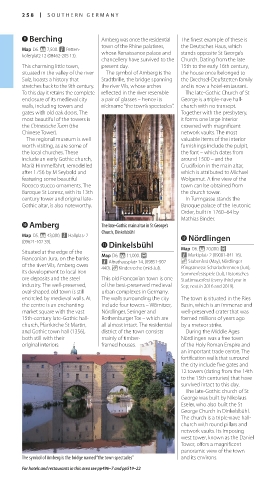
The symbol of Amberg is the bridge named “the town spectacles” and its environs. Orangery of the Markgräfliche residence, in Ansbach
For hotels and restaurants in this area see pp496–7 and pp519–22
258-259_EW_Germany.indd 258 09/10/17 1:00 pm 258-259_EW_Germany.indd 259 09/10/17 1:00 pm

