


Page 28 - (DK Eyewitness) Travel Guide - Germany
P. 28
26 INTRODUCING GERM AN Y A POR TR AIT OF GERM AN Y 27
Society and Politics Although reunification took place
Germany has almost always been on 3 October, 1990, unity among
divided regionally into states with the people themselves has taken a
fluctuating borders. The present-day long time. For a while, the former
states were, for the most part, created GDR tended to regard their
after 1945 while those in East Germany western counterparts as arrogant
were not created until 40 years later. and self-assured, while the latter
In all cases, old territorial and claimed that the inhabitants of the
historical ties were taken into account. “new states” were jealous and
That is the reason for their evocative ungrateful, resenting the billions
names, such as the “Free State of of marks and euros that were Bathers on the sandy beaches of Norddeich
Bavaria” or the “Free State of Saxony”. poured into impoverished regions
There are now 16 federal states, or to help equalize living standards. Today, Germany is on the rise, especially in cities,
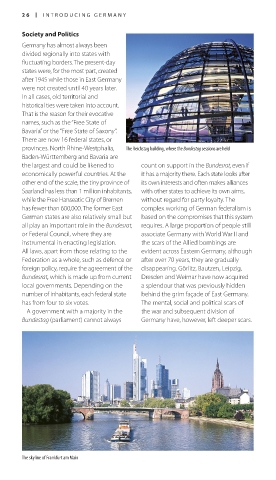
provinces. North Rhine-Westphalia, The Reichstag building, where the Bundestag sessions are held despite an on-going imbalance of wealth, as is the number of people who are
Baden-Württemberg and Bavaria are with East Germany still suffering from a seemingly uninterested in having a family.
the largest and could be likened to count on support in the Bundesrat, even if higher unemployment rate than the West, As a result, the German birth rate has been
economically powerful countries. At the it has a majority there. Each state looks after tensions have eased and the focus is declining. This population decline is some-
other end of the scale, the tiny province of its own interests and often makes alliances generally on working together. thing that the government has been trying
Saarland has less than 1 million inhabitants, with other states to achieve its own aims, As the leading country within to address in recent years – hence the
while the Free Hanseatic City of Bremen without regard for party loyalty. The the European Union in terms open-door policy on immigration.
has fewer than 600,000. The former East complex working of German federalism is of GDP, the country has also Great emphasis is still placed on art,
German states are also relatively small but based on the compromises that this system been in the political spotlight for culture and intellectual pursuits, which for
all play an important role in the Bundesrat, requires. A large proportion of people still the last few years. Many within many provides a satisfying counterbalance
or Federal Council, where they are associate Germany with World War II and Germany consider their country to the country’s industrial and commercial
instrumental in enacting legislation. the scars of the Allied bombings are a bastion of liberal democracy life. Germans also make the most of public
All laws, apart from those relating to the evident across Eastern Germany, although in a western world that is holidays and enjoy festivals. They are
Federation as a whole, such as defence or after over 70 years, they are gradually increasingly turning to populism. also among Europe’s most enthusiastic
foreign policy, require the agreement of the disappearing. Görlitz, Bautzen, Leipzig, travellers, with the country’s population
Bundesrat, which is made up from current Dresden and Weimar have now acquired Daily Life spending more than 68 billion euros on
local governments. Depending on the a splendour that was previously hidden Germany is commonly regarded holidays abroad every year.
number of inhabitants, each federal state behind the grim façade of East Germany. as a well-organised country
has from four to six votes. The mental, social and political scars of and – with the slightly unruly
A government with a majority in the the war and subsequent division of Participant in a exception of Berlin – this is
Bundestag (parliament) cannot always Germany have, however, left deeper scars. parade celebrating largely true. Many Germans
the Reunification continue to embrace old-
fashioned values such
as orderliness and industriousness,
punctuality and privacy. This is especially
true in working life, where they tend to be
on time for meetings and manage their
time well. To many, such behaviour can
come across as perfectionist, even stoic,
yet their humour and sense of community
should not be underestimated.
Lifestyles here tend to be typically West-
ern, with education and career both high
priorities. The main religion is Christianity
and while this is in decline, the culture does
remain vibrant in some places. The number
The skyline of Frankfurt am Main of people choosing to live alone in The upper town of Meersberg, with the Bodensee below
024-027_EW_Germany.indd 26 09/10/17 12:20 pm 024-027_EW_Germany.indd 27 09/10/17 12:20 pm

