


Page 31 - (DK Eyewitness) Travel Guide - Germany
P. 31
A POR TR AIT OF GERM AN Y 29
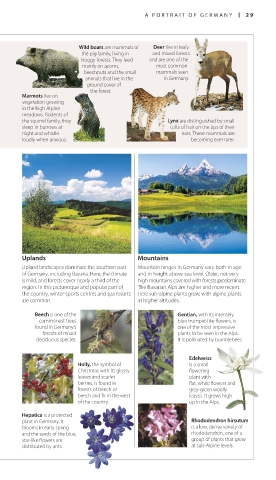
Wild boars are mammals of Deer live in leafy
the pig family, living in and mixed forests
boggy forests. They feed and are one of the
mainly on acorns, most common
beechnuts and the small mammals seen
animals that live in the in Germany.
ground cover of
the forest.
Marmots live on
vegetation growing
in the high Alpine
meadows. Rodents of
the squirrel family, they Lynx are distinguished by small
sleep in burrows at tufts of hair on the tips of their
night and whistle ears. These mammals are
loudly when anxious. becoming ever rarer.
Uplands Mountains
Upland landscapes dominate the southern part Mountain ranges in Germany vary both in age
of Germany, including Bavaria. Here, the climate and in height above sea level. Older, not very
is mild, and forests cover nearly a third of the high mountains covered with forests predominate.
region. In this picturesque and popular part of The Bavarian Alps are higher and more recent.
the country, winter-sports centres and spa resorts Here sub-alpine plants grow, with alpine plants
are common. at higher altitudes.
Beech is one of the Gentian, with its intensely
commonest trees blue trumpet-like flowers, is
found in Germany’s one of the most impressive
forests of mixed plants to be seen in the Alps.
deciduous species. It is pollinated by bumblebees.
Edelweiss
Holly, the symbol of is a small
Christmas with its glossy flowering
leaves and scarlet plant with
berries, is found in flat, white flowers and
forests of beech or grey-green woolly
beech and fir in the west leaves. It grows high
of the country. up in the Alps.
Hepatica is a protected
plant in Germany. It Rhododendron hirsutum
blooms in early spring is a low, dense variety of
and the seeds of the blue, rhododendron, one of a
star-like flowers are group of plants that grow
distributed by ants. at sub-Alpine levels.
028-029_EW_Germany.indd 29 09/10/17 12:24 pm

