


Page 33 - (DK Eyewitness) Travel Guide - Germany
P. 33
A POR TR AIT OF GERM AN Y 31
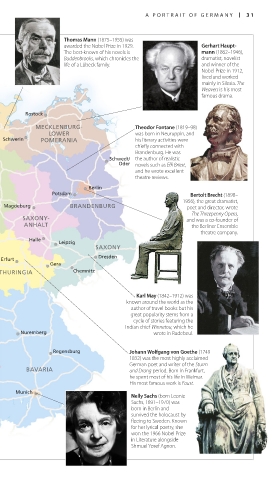
Thomas Mann (1875–1955) was
awarded the Nobel Prize in 1929. Gerhart Haupt-
The best-known of his novels is mann (1862–1946),
Buddenbrooks, which chronicles the dramatist, novelist
life of a Lübeck family. and winner of the
Nobel Prize in 1912,
lived and worked
mainly in Silesia. The
Weavers is his most
famous drama.
Kiel
SCHLESWIG- Rostock
HOLSTEIN
MECKLENBURG- Theodor Fontane (1819–98)
LOWER was born in Neuruppin, and
Bremerhaven Hamburg Schwerin POMERANIA his literary activities were
chiefly connected with
Brandenburg. He was
Schwedt/ the author of realistic
Bremen Oder novels such as Effi Briest,
and he wrote excellent
LOWER SAXONY, theatre reviews.
HAMBURG AND BREMEN
Berlin
Potsdam Bertolt Brecht (1898–
Hanover
1956), the great dramatist,
Magdeburg BRANDENBURG poet and director, wrote
The Threepenny Opera,
Bielefeld SAXONY- and was a co-founder of
ANHALT the Berliner Ensemble
Dortmund theatre company.
Halle Leipzig
NORTH RHINE- Kassel SAXONY
Düsseldorf WESTPHALIA
Erfurt Dresden
Gera
Bonn THURINGIA Chemnitz
HESSE
Karl May (1842–1912) was
known around the world as the
RHINELAND- Frankfurt author of travel books but his
PALATINATE AND am Main great popularity stems from a
SAARLAND cycle of stories featuring the
Indian chief Winnetou, which he
Nuremberg wrote in Radebeul.
Saarbrücken
Regensburg Johann Wolfgang von Goethe (1749–
1832) was the most highly acclaimed
Stuttgart German poet and writer of the Sturm
BAVARIA und Drang period. Born in Frankfurt,
he spent most of his life in Weimar.
BADEN- His most famous work is Faust.
WÜRTTEMBERG Munich
Nelly Sachs (born Leonie
Sachs, 1891–1970) was
born in Berlin and
survived the holocaust by
fleeing to Sweden. Known
for her lyrical poetry, she
won the 1966 Nobel Prize
in Literature alongside
Shmuel Yosef Agnon.
030-031_EW_Germany.indd 31 09/10/17 12:46 pm

