


Page 16 - All About History - Issue 16-14
P. 16
Transport


         Day in the life


        A CAPTAIN OF THE


        EAST INDIA COMPANY


         PROVIDING EXOTIC GOODS TO THE BRITISH

         EMPIRE, EAST INDIES, 18TH CENTURY


             One of the largest and most prominent organisations in the British
             Empire, the East India Company’s peak was in the 18th century
             when Britain’s trading presence was most strongly felt in the Indian
             subcontinent. At its height, the company transported all manner of
             goods around the world. The captains guided their vessels around
             the world and were vital cogs of this industry. Life was tough
             on the open sea, with its piracy, storms and long hours,
             but there was also the opportunity for them to
             line their own pockets…
                LOCAL EMPLOYMENT


                A captain had to make sure he had a
                full crew so he could safely travel the
                long distances expected. To satisfy
                these demands, Indian locals were often
                employed. The captain would choose from
                the neighbouring area those he felt were
                best suited for the role. Locals, known as   A British copper coin from 1808
                Lascars, were most commonly hired and   with the East India Company logo
                                                     emblazoned on it
                upon training worked extremely hard for
                little pay, which could be as little as five
                per cent of a British sailor’s wages.

                RENDEZVOUS WITH
                SUPERIORS


                A captain was constantly in communication
                with either London or the East India House. The
                Empire’s capital didn’t always have the final say,
                though, and less direction came from London as
                time wore on, giving the captains greater autonomy.
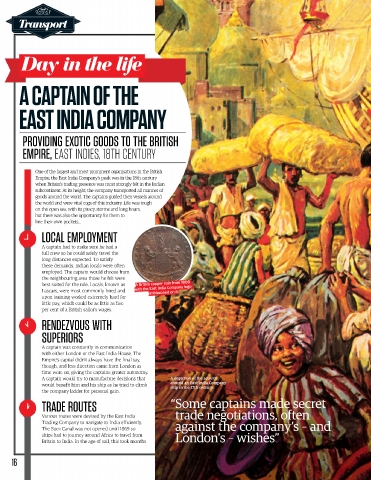
                A captain would try to manufacture decisions that   A depiction of the activity
                would benefit him and his ship as he tried to climb   around an East India Company
                                                             ship in the 17th century
                the company ladder for personal gain.
                TRADE ROUTES                                 “ Some captains made secret

                Various routes were devised by the East India   trade negotiations, often
                Trading Company to navigate to India efficiently.
                The Suez Canal was not opened until 1869 so    against the company’s – and
                ships had to journey around Africa to travel from   London’s – wishes”
                Britain to India. In the age of sail, this took months


     16

