


Page 17 - All About History - Issue 16-14
P. 17
Transport


                                                                                       and the captain’s method of navigating was to
                             How do we know this?                                      use a Mariner’s compass, which used a precise
                             The research for this article came from a variety         magnetised steel needle.
                             of sources each examining different aspects of
                             the captain’s role. Perhaps the most important
                             however was HV Bowen’s The Business Of Empire:            COLLECT AND
                             The East India Company And Imperial Britain 1756-
                             1833. Specifically designed for the period that the       DELIVER GOODS
                             article covered, the book gave a valuable insight
                             into a captain’s life aboard a trading ship for the       The lion’s share of the day would be spent
                             East India Company. This book also described the          gathering spices and goods to swell the company
                             hierarchy in the organisation well.
                                                                                       and Empire’s economic might. Out on the high
                                                                                       seas, the captain’s ship would often come into
                                                                                       contact with rival Dutch, French and Spanish
                                                                                       fleets, as unscrupulous rivals could steal cargo.
                                                                                       The Fourth Anglo-Dutch War (1780-84) ended with
                                                                                       a British victory as the companies and nations
                                                                                       squabbled over trade routes and land.
                                                                                       UNDERHAND DEALS

                                                                                       Some captains made secret trade negotiations, often
                                                                                       against the company’s – and London’s – wishes, to
                                                                                       boost their reputation and wealth. As a result, Pitt’s
                                                                                       India Act (named for UK’s Prime Minister William
                                                                                       Pitt the Younger) in 1784 gave control to both the
                                                                                       crown and the company in an attempt to make
                                                                                       the ailing firm work more efficiently. Indian ports
                                                                                       soon became corrupt as British rule was stretched
                                                                                       so thinly that effective policing of the situation was
                                                                                       almost impossible.
                                                                                       REPAIR SHIPS AND MONITOR

                                                                                       TRADE ZONE

                                                                                       The British ruled two-thirds of India by the end of
                                                                                       the 18th century, including many major cities such
                                                                                       as Bombay, Calcutta and Madras. To maintain the
                                                                                       Empire’s borders, the captains were equipped with
                                                                                       some of the largest ships ever constructed in the
                                                                                       era. These ships were built for cargo capacity and
                                                                                       not speed so could only reach seven to eight knots
                                                                                       before the age of steam arrived.
                                                                                       RAISING A FAMILY

                                                                                       For an East India Company captain, it was very
                                                                                       common to spend an extended time away from
                                                                                       the comforts of home. As a result, many began
                                                                                       relationships with Indian women and cross-cultural
                                                                                       marriages were common. Wills recovered from the
                                                                                       1780s show that a third of the company’s British
                                                                                       men left their possessions to their Indian family.

                                                                                       DOCKING INTO PORT

                                                                                       A company galleon was designed as much for
                                                                                       comfort as it was for carrying capacity. Known as
                                                                                       ‘Lords of the Ocean’, a captain and his crew could
                                                                                       easily sleep in the grand ship rather than spending
                                                                                       the night in cities such as Bombay and Calcutta.   © Look and Learn; Alamy; Cambridge University Press
                                                                                       Large ships such as the ‘Warley’ would be adorned
                                                                                       by the captain’s own choice of decoration.


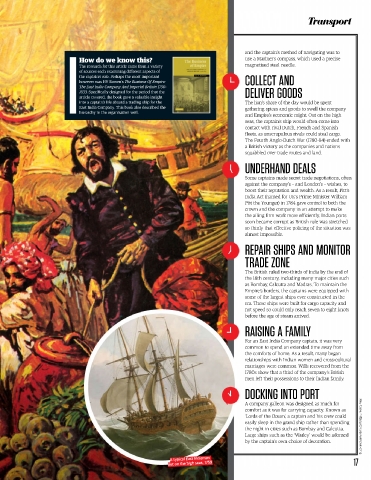
                                                             A typical East Indiaman
                                                            out on the high seas, 1759                                       17

