


Page 34 - All About History - Issue 16-14
P. 34
Through History


             TIMEKEEPING


               Humankind has always tried to master time, building increasingly
              ingenious devices in which to record it. Here we take a look at some

                                of timekeeping’s most important milestones


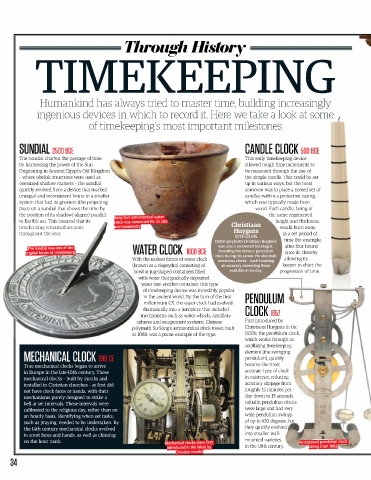
        SUNDIAL  2500 BCE                                                              CANDLE CLOCK  500 BCE
        The sundial charted the passage of time                                        This early timekeeping device
        by harnessing the power of the Sun.                                            allowed rough time increments to
        Originating in Ancient Egypt’s Old Kingdom                                     be measured through the use of
        – where obelisk structures were used as                                        the simple candle. This could be set
        oversized shadow markers – the sundial                                         up in various ways, but the most
        quickly evolved from a device that marked                                      common was to place a scored set of
        unequal and inconsistent hours to a smaller                                    candles within a protective casing,
        system that had its gnomon (the projecting                                     which was typically made from
        piece on a sundial that shows the time by                                          wood. Each candle, being of
        the position of its shadow) aligned parallel                                            the same regimented
                                         Sung Su’s astronomical water
        to Earth’s axi  This ensured that its   lock was renowned for its size                    height and thickness,
                                                  y                               Christiaan       would burn away
                                                                                   Huygens          in a set period of
                                                                                    DUTCH 1629-1695
                                                                             Dutch polymath Christiaan Huygens   time (for example,
           The sundial was one of the                                         was also a renowned horologist,   after four hours)
          original forms of timekeeping           ATER CLOCK   1600 BCE       inventing the famous pendulum   once lit, thereby
                                                                             clock during his career. He also built
                                                 th the earliest forms of water clock   numerous clocks – each boasting   allowing its
                                                  own as a clepsydra) consisting of   an accuracy exceeding those   keeper to chart the
                                                  wl or jug-shaped containers filled   available in his day.   progression of time.
                                                  with water that gradually deposited
                                                   water into another container, this type
                                                   of timekeeping device was incredibly popular
                                                   in the ancient world. By the turn of the first   PENDULUM
                                                   millennium CE, the water clock had evolved
                                                   dramatically into a timepiece that included   CLOCK   1657
                                                  mechanisms such as water wheels, armillary
                                                  pheres and escapement systems. Chinese   First introduced by
                                                  ymath Su Song’s astronomical clock tower, built   Christiaan Huygens
                                                   088, was a prime example of the type.  1650s, the pendulum
                                                                                       which works throug
                                                                                       oscillating timekeep
                                                                                       element (the swingi
         MECHANICAL CLOCK  990 CE                                                      pendulum), quickly
         True mechanical clocks began to arrive                                        became the most
         in Europe in the late-10th century. These                                     accurate type of cloc
         mechanical clocks – built by monks and                                        in existence, reducin
         installed in Christian churches – at first did                                accuracy slippage fro
         not have clock faces or hands, with their                                     roughly 15 minutes
         mechanisms purely designed to strike a                                        day down to 15 seco
         bell at set intervals. These intervals were                                   Initially, pendulum c
         calibrated to the religious day, rather than on                               were large and had v
         an hourly basis, identifying when set tasks,                                  wide pendulum swi
         such as praying, needed to be undertaken. By                                  of up to 100 degrees
         the 14th century mechanical clocks evolved                                    they quickly evolved
         to sport faces and hands, as well as chiming                                  into smaller, wall-
         on the hour mark.                                 Mechanical clocks were first   mounted varieties   An exposed pendulum clock
                                                            introduced in the West by   in the 18th century.  dating from 1883
                                                               Christian monks
     34

