


Page 35 - All About History - Issue 16-14
P. 35
Through History
Jean
Adrien Philippe
FRENCH 1815-1894
Cofounder of Patek Philippe & Co
in Geneva, Switzerland, he became WATCH
famous for inventing a mechanism
for watches that allowed them to be © Deutsches Uhrenmuseum
wound and set by crown rather than
key. Philippe went on to publish watches capable of
Les Montres Sans Clef on n on the arm date
pocket watches.
e 16th century,
n’t until Swiss
ker Dimier Frères
nted a wristwatch
ern-style wire
The pocket watch was only 03 that they really
made feasible by the invention he wristwatch
of the balance spring
me popular in
circles, with its
e of consultation
en as ideal for
ynchronising
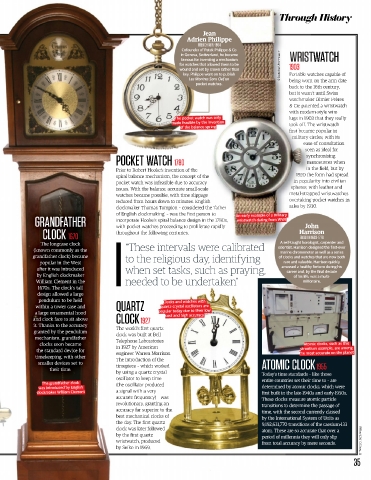
POCKET WATCH 1780 manoeuvres when
Prior to Robert Hooke’s invention of the the field, but by
spiral balance mechanism, the concept of the he form had spread
pocket watch was infeasible due to accuracy larity into civilian
issues. With the balance, accurate small-scale with leather and
watches became possible, with time slippage pped wristwatches
reduced from hours down to minutes. English g pocket watches in
clockmaker Thomas Tompion – considered the 930.
of English clockmaking’ – was the first person An early example of a military
GRANDFATHER incorporate Hooke’s spiral balance design in th wristwatch dating from WWI John
with pocket watches proceeding to proliferate
CLOCK 1670 throughout the following centuries. Harrison
ENGLISH 1693-1776
The longcase clock A self-taught horologist, carpenter and
(known commonly as the “These intervals were calibrated scientist, Harrison designed the first-ever
marine chronometer as well as a series
grandfather clock) became to the religious day, identifying of clocks and watches that are now both
popular in the West rare and valuable. Harrison quickly
after it was introduced when set tasks, such as praying, amassed a healthy fortune during his
career and, by the final decade
by English clockmaker of his life, was a multi-
William Clement in the needed to be undertaken” millionaire.
1670s. The clock’s tall
design allowed a large
pendulum to be held Clocks and watches with
within a tower case and QUARTZ quartz-crystal oscillators are
a large ornamental hood popular today due to their low
cost and high accuracy
and clock face to sit above CLOCK 1927
it. Thanks to the accuracy
The world’s first quartz
granted by the pendulum
clock was built at Bell
mechanism, grandfather
Telephone Laboratories
clocks soon became Atomic clocks, such as this
in 1927 by American
the standard device for strontium example, are among
engineer Warren Morrison. the most accurate on the planet
timekeeping, with other
The introduction of the
smaller devices set to
timepiece – which worked ATOMIC CLOCK 1955
their time.
by using a quartz crystal
Today’s time standards – like those
oscillator to keep time
The grandfather clock (the oscillator produced entire countries set their time to – are
was introduced by English determined by atomic clocks, which were
clockmaker William Clement a signal with a very first built in the late-1940s and early-1950s.
accurate frequency) – was
These clocks measure atomic particle
revolutionary, granting an
transitions to determine the passage of
accuracy far superior to the
time, with the second currently classed
best mechanical clocks of
by the International System of Units as
the day. The first quartz
9,192,631,770 transitions of the caesium-133
clock was later followed
atom. These are so accurate that over a
by the first quartz
period of millennia they will only slip
wristwatch, produced © Thinkstock; Getty Images
from total accuracy by mere seconds.
by Seiko in 1969.
35

