


Page 104 - Forbes - Asia (December 2019 - January 2020)
P. 104
STRATEGIES


              Bravo eventually headed west to
           Stanford University. He’d already been
           accepted into its law school, but he also
           wanted to attend the business school.
           He called insistently and eventually got
           accepted to pursue both. He worked
           during a summer at Seaver Kent, a
           Menlo Park, California-based joint
           venture with David Bonderman’s Texas
           Pacific Group that specialized in middle
           market deals. Upon graduation in 1998,
           Bravo wasn’t offered a position there
           or at TPG, and he spent months cold-
           calling for a job. After about a hundred
           calls, Bravo’s résumé caught the eye
           of Carl Thoma, a founding partner of
           the Chicago-based private equity firm
           Golder, Thoma, Cressey, Rauner
           (now known as GTCR), and they hit it
           off. “The biggest mistake Texas Pacific
           made was. . . that they didn’t make him
           a job offer,” says Thoma, 71, who Forbes
           estimates is also a billionaire based on
           an analysis of public filings.
              One of the pioneers of the private
           equity industry in the 1970s, Thoma is
           a tall and mild-mannered Oklahoman
           whose parents were ranchers. Thoma
           and his partners practiced a friendlier
           version of the buyouts popularized by
           Michael Milken, preferring to buy small
           businesses and expand them using ac-
           quisitions. When Bravo came aboard
           in 1998, Thoma and partner Bryan
           Cressey had just split from Stanley


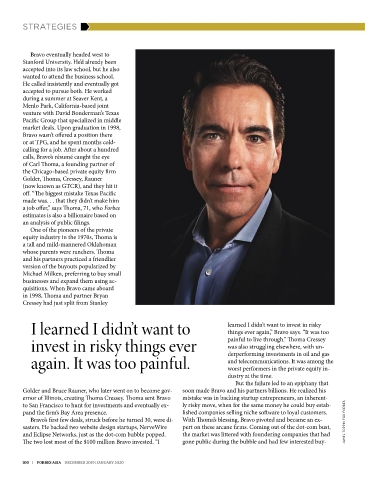
              I learned I didn’t want to                                                           learned I didn’t want to invest in risky
                                                                                                   things ever again,” Bravo says. “It was too

              invest in risky things ever                                                          painful to live through.” Thoma Cressey
                                                                                                   was also struggling elsewhere, with un-
                                                                                                   derperforming investments in oil and gas
              again. It was too painful.                                                           and telecommunications. It was among the
                                                                                                   worst performers in the private equity in-
                                                                                                   dustry at the time.
                                                                                                      But the failure led to an epiphany that
           Golder and Bruce Rauner, who later went on to become gov-           soon made Bravo and his partners billions. He realized his
           ernor of Illinois, creating Thoma Cressey. Thoma sent Bravo         mistake was in backing startup entrepreneurs, an inherent-
           to San Francisco to hunt for investments and eventually ex-         ly risky move, when for the same money he could buy estab-
           pand the firm’s Bay Area presence.                                  lished companies selling niche software to loyal customers.
              Bravo’s first few deals, struck before he turned 30, were di-    With Thoma’s blessing, Bravo pivoted and became an ex-                JAMEL TOPPIN FOR FORBES
           sasters. He backed two website design startups, NerveWire           pert on these arcane firms. Coming out of the dot-com bust,
           and Eclipse Networks, just as the dot-com bubble popped.            the market was littered with foundering companies that had
           The two lost most of the $100 million Bravo invested. “I            gone public during the bubble and had few interested buy-


           100     |     FORBES ASIA     DECEMBER 2019 / JANUARY 2020

