


Page 106 - Ultimate Visual Dictionary (DK)
P. 106
PREHISTORIC EAR TH

      Mammals 1

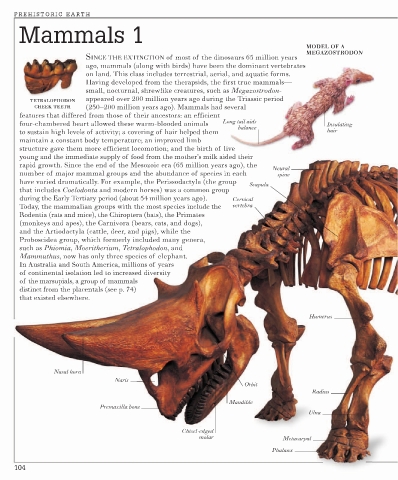
                                                                                      MODEL OF A
                                                                                      MEGAZOSTRODON
                         SINCE THE EXTINCTION of most of the dinosaurs 65 million years
                         ago, mammals (along with birds) have been the dominant vertebrates
                         on land. This class includes terrestrial, aerial, and aquatic forms.
                         Having developed from the therapsids, the first true mammals—
                         small, nocturnal, shrewlike creatures, such as Megazostrodon-
         TETRALOPHODON   appeared over 200 million years ago during the Triassic period
           CHEEK TEETH   (250–200 million years ago). Mammals had several
      features that differed from those of their ancestors: an efficient
      four-chambered heart allowed these warm-blooded animals    Long tail aids             Insulating
                                                                   balance
      to sustain high levels of activity; a covering of hair helped them                    hair
      maintain a constant body temperature; an improved limb
      structure gave them more efficient locomotion; and the birth of live
      young and the immediate supply of food from the mother’s milk aided their
      rapid growth. Since the end of the Mesozoic era (65 million years ago), the
                                                                             Neural
      number of major mammal groups and the abundance of species in each      spine
      have varied dramatically. For example, the Perissodactyla (the group
                                                                      Scapula
      that includes Coelodonta and modern horses) was a common group
      during the Early Tertiary period (about 54 million years ago).   Cervical
      Today, the mammalian groups with the most species include the   vertebra
      Rodentia (rats and mice), the Chiroptera (bats), the Primates
      (monkeys and apes), the Carnivora (bears, cats, and dogs),
      and the Artiodactyla (cattle, deer, and pigs), while the
      Proboscidea group, which formerly included many genera,
      such as Phiomia, Moeritherium, Tetralophodon, and
      Mammuthus, now has only three species of elephant.
      In Australia and South America, millions of years
      of continental isolation led to increased diversity
      of the marsupials, a group of mammals
      distinct from the placentals (see p. 74)
      that existed elsewhere.

                                                                                       Humerus


                Nasal horn
                                 Naris
                                                                     Orbit
                                                                                        Radius
                                                                 Mandible
                             Premaxilla bone
                                                                                       Ulna

                                                    Chisel-edged
                                                        molar                   Metacarpal
                                                                             Phalanx

     104

