


Page 110 - Ultimate Visual Dictionary (DK)
P. 110
PREHISTORIC EAR TH

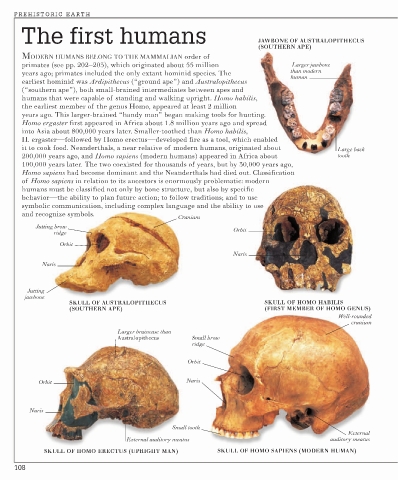
       The first humans                                                  JAWBONE OF AUSTRALOPITHECUS

                                                                         (SOUTHERN APE)
       MODERN HUMANS BELONG TO THE MAMMALIAN order of
       primates (see pp. 202–203), which originated about 55 million               Larger jawbone
       years ago; primates included the only extant hominid species. The          than modern
                                                                                  human
       earliest hominid was Ardipithecus (“ground ape”) and Australopithecus
       (“southern ape”), both small-brained intermediates between apes and
       humans that were capable of standing and walking upright. Homo habilis,
       the earliest member of the genus Homo, appeared at least 2 million
       years ago. This larger-brained “handy man” began making tools for hunting.
       Homo ergaster first appeared in Africa about 1.8 million years ago and spread
       into Asia about 800,000 years later. Smaller-toothed than Homo habilis,
       H. ergaster—followed by Homo erectus—developed fire as a tool, which enabled
       it to cook food. Neanderthals, a near relative of modern humans, originated about       Large back
       200,000 years ago, and Homo sapiens (modern humans) appeared in Africa about            tooth
       100,000 years later. The two coexisted for thousands of years, but by 30,000 years ago,
       Homo sapiens had become dominant and the Neanderthals had died out. Classification
       of Homo sapiens in relation to its ancestors is enormously problematic: modern
       humans must be classified not only by bone structure, but also by specific
       behavior—the ability to plan future action; to follow traditions; and to use
       symbolic communication, including complex language and the ability to use
       and recognize symbols.
                                                  Cranium
           Jutting brow
                ridge                                             Orbit
                  Orbit
                                                                  Naris
             Naris


         Jutting
        jawbone
                    SKULL OF AUSTRALOPITHECUS                              SKULL OF HOMO HABILIS
                    (SOUTHERN APE)                                         (FIRST MEMBER OF HOMO GENUS)
                                                                                               Well-rounded
                                                                                                   cranium
                                  Larger braincase than
                                  Australopithecus    Small brow
                                                      ridge

                                                     Orbit


            Orbit                                    Naris


         Naris

                                                 Small tooth
                                                                                                  External
                                    External auditory meatus                                 auditory meatus
             SKULL OF HOMO ERECTUS (UPRIGHT MAN)             SKULL OF HOMO SAPIENS (MODERN HUMAN)

     108

