


Page 114 - Ultimate Visual Dictionary (DK)
P. 114
PLANTS

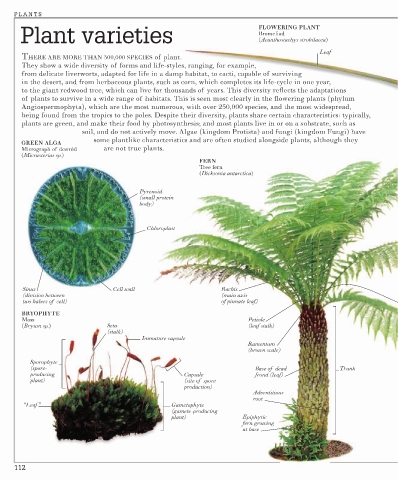
       Plant varieties                                                   FLOWERING PLANT
                                                                         Bromeliad
                                                                         (Acanthostachys strobilacea)
                                                                                          Leaf
       THERE ARE MORE THAN 300,000 SPECIES of plant.
       They show a wide diversity of forms and life-styles, ranging, for example,
       from delicate liverworts, adapted for life in a damp habitat, to cacti, capable of surviving
       in the desert, and from herbaceous plants, such as corn, which completes its life-cycle in one year,
       to the giant redwood tree, which can live for thousands of years. This diversity reflects the adaptations
       of plants to survive in a wide range of habitats. This is seen most clearly in the flowering plants (phylum
       Angiospermophyta), which are the most numerous, with over 250,000 species, and the most widespread,
       being found from the tropics to the poles. Despite their diversity, plants share certain characteristics: typically,
       plants are green, and make their food by photosynthesis; and most plants live in or on a substrate, such as
                        soil, and do not actively move. Algae (kingdom Protista) and fungi (kingdom Fungi) have
                           some plantlike characteristics and are often studied alongside plants, although they
       GREEN ALGA
       Micrograph of desmid   are not true plants.
       (Micrasterias sp.)
                                                        FERN
                                                        Tree fern
                                                        (Dicksonia antarctica)

                                        Pyrenoid
                                        (small protein
                                        body)


                                          Chloroplast


       Sinus                    Cell wall                     Rachis
       (division between                                      (main axis
       two halves of  cell)                                   of pinnate leaf)
       BRYOPHYTE
       Moss                                                           Petiole
       (Bryum sp.)             Seta                                   (leaf stalk)
                               (stalk)
                                        Immature capsule
                                                                      Ramentum
                                                                      (brown scale)
         Sporophyte
         (spore-                                                        Base of  dead          Trunk
         producing                                  Capsule             frond (leaf)
         plant)                                     (site of  spore
                                                    production)
                                                                       Adventitious
                                                                       root
       “Leaf”                                    Gametophyte
                                                 (gamete-producing
                                                 plant)             Epiphytic
                                                                    fern growing
                                                                    at base


     112

