


Page 12 - Ultimate Visual Dictionary (DK)
P. 12
THE UNIVERSE

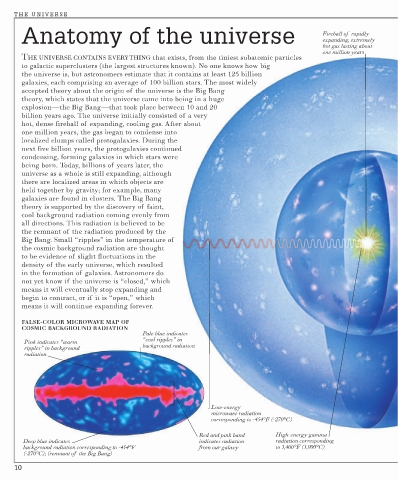
       Anatomy of the universe                                                             Fireball of  rapidly
                                                                                           expanding, extremely
                                                                                           hot gas lasting about
                                                                                           one million years
       THE UNIVERSE CONTAINS EVERYTHING that exists, from the tiniest subatomic particles
       to galactic superclusters (the largest structures known). No one knows how big
       the universe is, but astronomers estimate that it contains at least 125 billion
       galaxies, each comprising an average of 100 billion stars. The most widely
       accepted theory about the origin of the universe is the Big Bang
       theory, which states that the universe came into being in a huge
       explosion—the Big Bang—that took place between 10 and 20
       billion years ago. The universe initially consisted of a very
       hot, dense fireball of expanding, cooling gas. After about
       one million years, the gas began to condense into
       localized clumps called protogalaxies. During the
       next five billion years, the protogalaxies continued
       condensing, forming galaxies in which stars were
       being born. Today, billions of years later, the
       universe as a whole is still expanding, although
       there are localized areas in which objects are
       held together by gravity; for example, many
       galaxies are found in clusters. The Big Bang
       theory is supported by the discovery of faint,
       cool background radiation coming evenly from
       all directions. This radiation is believed to be
       the remnant of the radiation produced by the
       Big Bang. Small “ripples” in the temperature of
       the cosmic background radiation are thought
       to be evidence of slight fluctuations in the
       density of the early universe, which resulted
       in the formation of galaxies. Astronomers do
       not yet know if the universe is “closed,” which
       means it will eventually stop expanding and
       begin to contract, or if it is “open,” which
       means it will continue expanding forever.

       FALSE-COLOR MICROWAVE MAP OF
       COSMIC BACKGROUND RADIATION
                                         Pale blue indicates
                                         “cool ripples” in
        Pink indicates “warm
        ripples” in background           background radiation
        radiation


                                                            Low-energy
                                                            microwave radiation
                                                            corresponding to -454°F (-270°C)

                                                        Red and pink band     High-energy gamma
       Deep blue indicates                              indicates radiation   radiation corresponding
       background radiation corresponding to -454°F     from our galaxy       to 5,400°F (3,000°C)
       (-270°C); (remnant of  the Big Bang)

     10

