


Page 14 - Ultimate Visual Dictionary (DK)
P. 14
THE UNIVERSE
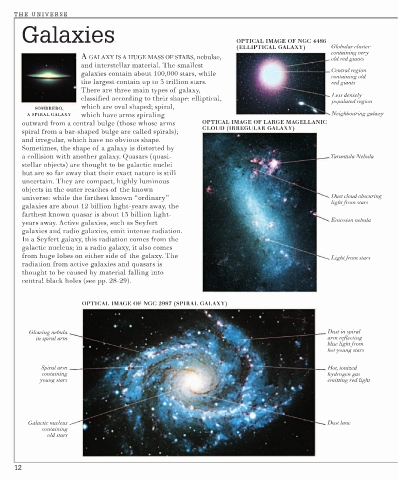
       Galaxies

                                                                   OPTICAL IMAGE OF NGC 4486
                                                                   (ELLIPTICAL GALAXY)       Globular cluster
                                                                                             containing very
                        A GALAXY IS A HUGE MASS OF STARS, nebulae,                           old red giants
                        and interstellar material. The smallest
                                                                                             Central region
                        galaxies contain about 100,000 stars, while
                                                                                             containing old
                        the largest contain up to 3 trillion stars.                          red giants
                        There are three main types of galaxy,
                                                                                             Less densely
                        classified according to their shape: elliptical,
                                                                                             populated region
                        which are oval shaped; spiral,
           SOMBRERO,
         A SPIRAL GALAXY  which have arms spiraling                                          Neighbouring galaxy
       outward from a central bulge (those whose arms    OPTICAL IMAGE OF LARGE MAGELLANIC
                                                         CLOUD (IRREGULAR GALAXY)
       spiral from a bar-shaped bulge are called spirals);
       and irregular, which have no obvious shape.
       Sometimes, the shape of a galaxy is distorted by
       a collision with another galaxy. Quasars (quasi-                                      Tarantula Nebula
       stellar objects) are thought to be galactic nuclei
       but are so far away that their exact nature is still
       uncertain. They are compact, highly luminous
       objects in the outer reaches of the known
       universe: while the farthest known “ordinary”                                         Dust cloud obscuring
                                                                                             light from stars
       galaxies are about 12 billion light-years away, the
       farthest known quasar is about 13 billion light-
       years away. Active galaxies, such as Seyfert                                          Emission nebula
       galaxies and radio galaxies, emit intense radiation.
       In a Seyfert galaxy, this radiation comes from the
       galactic nucleus; in a radio galaxy, it also comes
       from huge lobes on either side of the galaxy. The                                     Light from stars
       radiation from active galaxies and quasars is
       thought to be caused by material falling into
       central black holes (see pp. 28-29).


                        OPTICAL IMAGE OF NGC 2997 (SPIRAL GALAXY)


         Glowing nebula                                                                     Dust in spiral
           in spiral arm                                                                    arm reflecting
                                                                                            blue light from
                                                                                            hot young stars

            Spiral arm                                                                      Hot, ionized
             containing                                                                     hydrogen gas
            young stars                                                                     emitting red light


         Galactic nucleus                                                                   Dust lane
             containing
              old stars


     12

