


Page 16 - Ultimate Visual Dictionary (DK)
P. 16
THE UNIVERSE

       The Milky Way


                       THE MILKY WAY IS THE NAME GIVEN TO THE FAINT BAND OF LIGHT that stretches
                       across the night sky. This light comes from stars and nebulae in our galaxy, known as
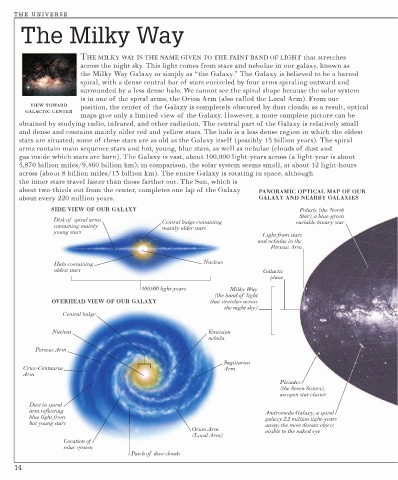
                       the Milky Way Galaxy or simply as “the Galaxy.” The Galaxy is believed to be a barred
                       spiral, with a dense central bar of stars encircled by four arms spiraling outward and
                       surrounded by a less dense halo. We cannot see the spiral shape because the solar system
                       is in one of the spiral arms, the Orion Arm (also called the Local Arm). From our
          VIEW TOWARD   position, the center of the Galaxy is completely obscured by dust clouds; as a result, optical
        GALACTIC CENTER
                       maps give only a limited view of the Galaxy. However, a more complete picture can be
      obtained by studying radio, infrared, and other radiation. The central part of the Galaxy is relatively small
      and dense and contains mainly older red and yellow stars. The halo is a less dense region in which the oldest
      stars are situated; some of these stars are as old as the Galaxy itself (possibly 13 billion years). The spiral
      arms contain main sequence stars and hot, young, blue stars, as well as nebulae (clouds of dust and
      gas inside which stars are born). The Galaxy is vast, about 100,000 light-years across (a light-year is about
      5,870 billion miles/9,460 billion km); in comparison, the solar system seems small, at about 12 light-hours
      across (about 8 billion miles/13 billion km). The entire Galaxy is rotating in space, although
      the inner stars travel faster than those farther out. The Sun, which is
      about two-thirds out from the center, completes one lap of the Galaxy   PANORAMIC OPTICAL MAP OF OUR
      about every 220 million years.                                     GALAXY AND NEARBY GALAXIES
               SIDE VIEW OF OUR GALAXY                                              Polaris (the North
                                                                                    Star), a blue-green
                Disk of  spiral arms
                                              Central bulge containing             variable binary star
                containing mainly             mainly older stars
                young stars
                                                                          Light from stars
                                                                         and nebulae in the
                                                                            Perseus Arm
                Halo containing                           Nucleus
                oldest stars                                              Galactic
                                                                            plane
                                        100,000 light-years      Milky Way
                                                             (the band of  light
               OVERHEAD VIEW OF OUR GALAXY                 that stretches across
                                                               the night sky)
                  Central bulge

               Nucleus                                     Emission
                                                           nebula
           Perseus Arm
                                                               Sagittarius
       Crux-Centaurus                                          Arm
       Arm
                                                                               Pleiades
                                                                               (the Seven Sisters),
                                                                               an open star cluster
         Dust in spiral
         arm reflecting                                                    Andromeda Galaxy, a spiral
         blue light from                                                   galaxy 2.2 million light-years
         hot young stars                                                   away; the most distant object
                                                      Orion Arm            visible to the naked eye
                                                      (Local Arm)
                   Location of
                   solar system
                                     Patch of  dust clouds

     14

