


Page 130 - Ultimate Visual Dictionary (DK)
P. 130
PLANTS

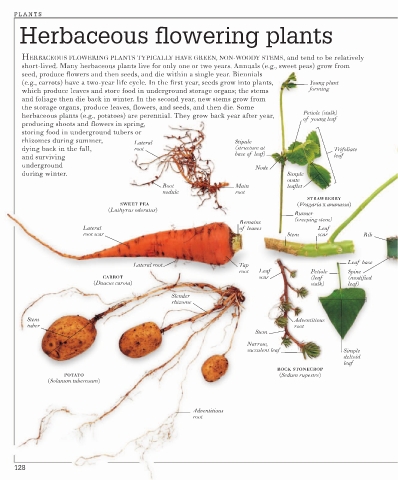
      Herbaceous flowering plants


       HERBACEOUS FLOWERING PLANTS TYPICALLY HAVE GREEN, NON-WOODY STEMS, and tend to be relatively
       short-lived. Many herbaceous plants live for only one or two years. Annuals (e.g., sweet peas) grow from
       seed, produce flowers and then seeds, and die within a single year. Biennials
       (e.g., carrots) have a two-year life cycle. In the first year, seeds grow into plants,   Young plant
       which produce leaves and store food in underground storage organs; the stems    forming
       and foliage then die back in winter. In the second year, new stems grow from
       the storage organs, produce leaves, flowers, and seeds, and then die. Some
                                                                                     Petiole (stalk)
       herbaceous plants (e.g., potatoes) are perennial. They grow back year after year,
                                                                                     of  young leaf
       producing shoots and flowers in spring,
       storing food in underground tubers or
       rhizomes during summer,        Lateral                     Stipule
       dying back in the fall,        root                        (structure at               Trifoliate
                                                                  base of  leaf)              leaf
       and surviving
       underground
                                                                        Node
       during winter.                                                            Simple
                                                                                 ovate
                                              Root                Main           leaflet
                                              nodule              root
                                                                                      STRAWBERRY
                                  SWEET PEA                                         (Fragaria x ananassa)
                               (Lathyrus odoratus)
                                                                                   Runner
                                                                                   (creeping stem)
                                                                    Remains
                        Lateral                                     of  leaves           Leaf
                        root scar                                                Stem    scar         Rib


                                                                                                  Leaf  base
                                      Lateral root                 Tap
                                                                   root  Leaf          Petiole    Spine
                              CARROT                                     scar          (leaf      (modified
                           (Daucus carota)                                             stalk)     leaf)
                                                 Slender
                                                 rhizome

         Stem                                                                      Adventitious
         tuber                                                                     root
                                                                        Stem
                                                                      Narrow,
                                                                      succulent leaf            Simple
                                                                                                deltoid
                                                                                                leaf
                                                                              ROCK STONECROP
                   POTATO                                                      (Sedum rupestre)
              (Solanum tuberosum)


                                                       Adventitious
                                                       root


     128

