


Page 132 - Ultimate Visual Dictionary (DK)
P. 132
PLANTS

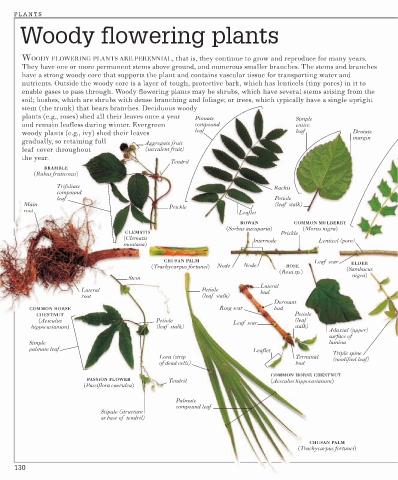
       Woody flowering plants


       WOODY FLOWERING PLANTS ARE PERENNIAL, that is, they continue to grow and reproduce for many years.
       They have one or more permanent stems above ground, and numerous smaller branches. The stems and branches
       have a strong woody core that supports the plant and contains vascular tissue for transporting water and
       nutrients. Outside the woody core is a layer of tough, protective bark, which has lenticels (tiny pores) in it to
       enable gases to pass through. Woody flowering plants may be shrubs, which have several stems arising from the
       soil; bushes, which are shrubs with dense branching and foliage; or trees, which typically have a single upright
       stem (the trunk) that bears branches. Deciduous woody
       plants (e.g., roses) shed all their leaves once a year   Pinnate            Simple
       and remain leafless during winter. Evergreen    compound                    entire
                                                       leaf                        leaf
       woody plants (e.g., ivy) shed their leaves                                                  Dentate
                                                                                                   margin
       gradually, so retaining full      Aggregate fruit
       leaf cover throughout             (succulent fruit)
       the year.
                                                Tendril
             BRAMBLE
          (Rubus fruticosus)
                 Trifoliate                                                  Rachis
                 compound
                 leaf                                                        Petiole
        Main                                    Prickle                      (leaf  stalk)
        root
                                                                   Leaflet
                                                                    ROWAN          COMMON MULBERRY
                                                                (Sorbus aucuparia)   (Morus nigra)
                                    CLEMATIS                                   Prickle
                                   (Clematis                           Internode          Lenticel (pore)
                                   montana)

                                               CHUSAN PALM                              Leaf  scar  ELDER
                                           (Trachycarpus fortunei)  Node  Node   ROSE            (Sambucus
                                                                               (Rosa sp.)
                                     Stem                                                          nigra)
                                                                         Lateral
                        Lateral                          Petiole         bud
                        root                             (leaf  stalk)
                                                                             Dormant
         COMMON HORSE                                         Ring scar      bud
           CHESTNUT                                                                Petiole
            (Aesculus                       Petiole               Leaf  scar       (leaf
          hippocastanum)                    (leaf  stalk)                          stalk)
                                                                                            Adaxial (upper)
                                                                                            surface of
         Simple                                                                             lamina
         palmate leaf                                                  Leaflet               Triple spine
                                             Lora (strip                           Terminal   (modified leaf)
                                             of dead cells)                        bud
                                                                            COMMON HORSE CHESTNUT
                         PASSION FLOWER         Tendril                     (Aesculus hippocastanum)
                        (Passiflora caerulea)
                                                  Palmate
                                                  compound leaf
                             Stipule (structure
                             at base of  tendril)


                                                                                       CHUSAN PALM
                                                                                    (Trachycarpus fortunei)


     130

