


Page 134 - Ultimate Visual Dictionary (DK)
P. 134
PLANTS

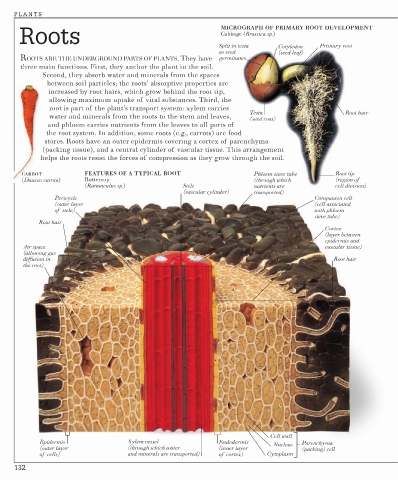
      Roots                                                   MICROGRAPH OF PRIMARY ROOT DEVELOPMENT
                                                              Cabbage (Brassica sp.)
                                                              Split in testa   Cotyledon   Primary root
                                                              as seed         (seed leaf)
       ROOTS ARE THE UNDERGROUND PARTS OF PLANTS. They have  germinates
       three main functions. First, they anchor the plant in the soil.
             Second, they absorb water and minerals from the spaces
              between soil particles; the roots’ absorptive properties are
              increased by root hairs, which grow behind the root tip,
               allowing maximum uptake of vital substances. Third, the
               root is part of the plant’s transport system: xylem carries
                                                                      Testa                      Root hair
               water and minerals from the roots to the stem and leaves,
                                                                      (seed coat)
              and phloem carries nutrients from the leaves to all parts of
              the root system. In addition, some roots (e.g., carrots) are food
             stores. Roots have an outer epidermis covering a cortex of parenchyma
             (packing tissue), and a central cylinder of vascular tissue. This arrangement
            helps the roots resist the forces of compression as they grow through the soil.

       CARROT            FEATURES OF A TYPICAL ROOT                     Phloem sieve tube     Root tip
       (Daucus carota)   Buttercup                                      (through which        (region of
                         (Ranunculus sp.)           Stele               nutrients are         cell division)
                                                    (vascular cylinder)  transported)
                Pericycle                                                               Companion cell
                (outer layer                                                            (cell associated
                of  stele)                                                              with phloem
                                                                                        sieve tube)
            Root hair
                                                                                           Cortex
                                                                                           (layer between
                                                                                           epidermis and
       Air space                                                                           vascular tissue)
       (allowing gas
       diffusion in                                                                           Root hair
       the root)


                                                                            Cell wall
            Epidermis               Xylem vessel              Endodermis     Nucleus  Parenchyma
            (outer layer            (through which water      (inner layer           (packing) cell
            of  cells)              and minerals are transported)  of  cortex)  Cytoplasm

     132

