


Page 168 - Ultimate Visual Dictionary (DK)
P. 168
ANIMALS

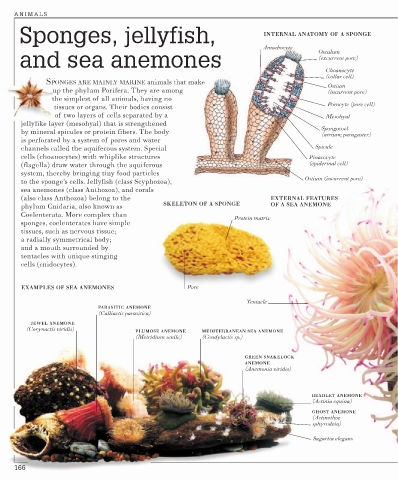
      Sponges, jellyfish,                                                 INTERNAL ANATOMY OF A SPONGE

                                                                          Amoebocyte     Osculum
      and sea anemones                                                                   (excurrent pore)

                                                                                           Choanocyte
                                                                                           (collar cell)
              SPONGES ARE MAINLY MARINE animals that make
                                                                                            Ostium
                up the phylum Porifera. They are among                                      (incurrent pore)
               the simplest of all animals, having no
                                                                                            Porocyte (pore cell)
                tissues or organs. Their bodies consist
                of two layers of cells separated by a                                       Mesohyal
       jellylike layer (mesohyal) that is strengthened
                                                                                          Spongocoel
       by mineral spicules or protein fibers. The body
                                                                                          (atrium; paragaster)
       is perforated by a system of pores and water
       channels called the aquiferous system. Special                                    Spicule
       cells (choanocytes) with whiplike structures                                    Pinacocyte
       (flagella) draw water through the aquiferous                                    (epidermal cell)
       system, thereby bringing tiny food particles
                                                                                      Ostium (incurrent pore)
       to the sponge’s cells. Jellyfish (class Scyphozoa),
       sea anemones (class Anthozoa), and corals
       (also class Anthozoa) belong to the                                  EXTERNAL FEATURES
                                              SKELETON OF A SPONGE          OF A SEA ANEMONE
       phylum Cnidaria, also known as
       Coelenterata. More complex than
                                                                  Protein matrix
       sponges, coelenterates have simple
       tissues, such as nervous tissue;
       a radially symmetrical body;
       and a mouth surrounded by
       tentacles with unique stinging
       cells (cnidocytes).


       EXAMPLES OF SEA ANEMONES                      Pore
                                                                     Tentacle
                            PARASITIC ANEMONE
                            (Calliactis parasitica)
          JEWEL ANEMONE
        (Corynactis viridis)
                                       PLUMOSE ANEMONE   MEDITERRANEAN SEA ANEMONE
                                       (Metridium senile)  (Condylactis sp.)

                                                                     GREEN SNAKELOCK
                                                                     ANEMONE
                                                                     (Anemonia viridis)


                                                                                        BEADLET ANEMONE
                                                                                        (Actinia equina)
                                                                                        GHOST ANEMONE
                                                                                        (Actinothoe
                                                                                        sphyrodeta)

                                                                                        Sagartia elegans


     166

