


Page 172 - Ultimate Visual Dictionary (DK)
P. 172
ANIMALS

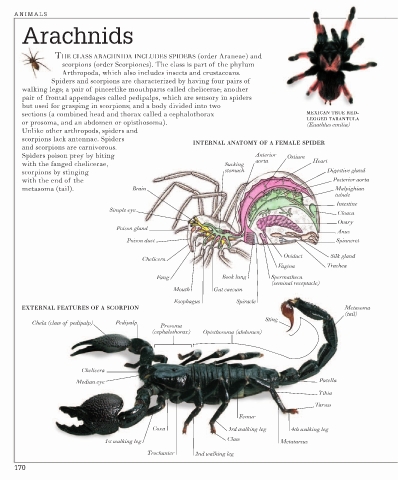
       Arachnids


                THE CLASS ARACHNIDA INCLUDES SPIDERS (order Araneae) and
                  scorpions (order Scorpiones). The class is part of the phylum
                  Arthropoda, which also includes insects and crustaceans.
               Spiders and scorpions are characterized by having four pairs of
       walking legs; a pair of pincerlike mouthparts called chelicerae; another
       pair of frontal appendages called pedipalps, which are sensory in spiders
       but used for grasping in scorpions; and a body divided into two
       sections (a combined head and thorax called a cephalothorax                    MEXICAN TRUE RED-
                                                                                      LEGGED TARANTULA
       or prosoma, and an abdomen or opisthosoma).                                    (Euathlus emilia)
       Unlike other arthropods, spiders and
       scorpions lack antennae. Spiders
                                                       INTERNAL ANATOMY OF A FEMALE SPIDER
       and scorpions are carnivorous.
       Spiders poison prey by biting                                    Anterior   Ostium
                                                                        aorta           Heart
       with the fanged chelicerae,                             Sucking
       scorpions by stinging                                   stomach                      Digestive gland
       with the end of the                                                                    Posterior aorta
       metasoma (tail).               Brain                                                   Malpighian
                                                                                              tubule
                                                                                              Intestine
                               Simple eye
                                                                                               Cloaca
                                                                                               Ovary
                                 Poison gland
                                                                                               Anus
                                    Poison duct                                               Spinneret

                                                                                Oviduct      Silk gland
                                        Chelicera
                                                                              Vagina        Trachea
                                             Fang              Book lung    Spermatheca
                                                                            (seminal receptacle)
                                                 Mouth      Gut caecum
                                                  Esophagus        Spiracle
       EXTERNAL FEATURES OF A SCORPION                                                           Metasoma
                                                                                                 (tail)
                                                                           Sting
          Chela (claw of  pedipalp)  Pedipalp
                                              Prosoma
                                           (cephalothorax)  Opisthosoma (abdomen)


                        Chelicera
                      Median eye                                                          Patella
                                                                                         Tibia
                                                                                        Tarsus
                                                                   Femur
                                           Coxa                 3rd walking leg   4th walking leg
                              1st walking leg                   Claw           Metatarsus
                                          Trochanter   2nd walking leg

     170

