


Page 178 - Ultimate Visual Dictionary (DK)
P. 178
ANIMALS

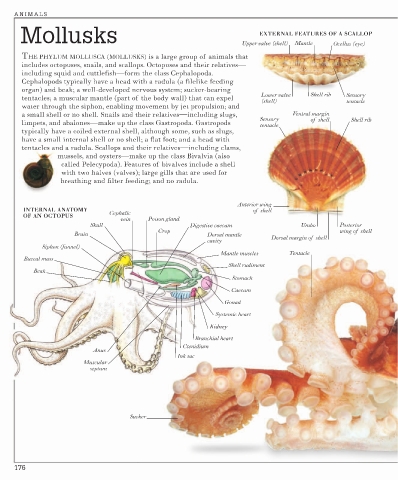
       Mollusks                                                     Upper valve (shell)  Mantle  Ocellus (eye)
                                                                         EXTERNAL FEATURES OF A SCALLOP

       THE PHYLUM MOLLUSCA (MOLLUSKS) is a large group of animals that
       includes octopuses, snails, and scallops. Octopuses and their relatives—
       including squid and cuttlefish—form the class Cephalopoda.
       Cephalopods typically have a head with a radula (a filelike feeding
       organ) and beak; a well-developed nervous system; sucker-bearing
                                                                          Lower valve   Shell rib  Sensory
       tentacles; a muscular mantle (part of the body wall) that can expel
                                                                          (shell)                tentacle
       water through the siphon, enabling movement by jet propulsion; and
       a small shell or no shell. Snails and their relatives—including slugs,     Ventral margin
                                                                         Sensory       of  shell   Shell rib
       limpets, and abalones—make up the class Gastropoda. Gastropods
                                                                         tentacle
       typically have a coiled external shell, although some, such as slugs,
       have a small internal shell or no shell; a flat foot; and a head with
       tentacles and a radula. Scallops and their relatives—including clams,
                 mussels, and oysters—make up the class Bivalvia (also
                  called Pelecypoda). Features of bivalves include a shell
                  with two halves (valves); large gills that are used for
                  breathing and filter feeding; and no radula.


                                                                   Anterior wing
       INTERNAL ANATOMY                                                of  shell
                               Cephalic
       OF AN OCTOPUS
                                   vein   Poison gland
                          Skull                       Digestive caecum               Umbo      Posterior
                                             Crop                                              wing of  shell
                      Brain                                Dorsal mantle
                                                           cavity           Dorsal margin of  shell
             Siphon (funnel)
                                                              Mantle muscles     Tentacle
        Buccal mass
                                                                 Shell rudiment
          Beak
                                                                 Stomach
                                                                 Caecum
                                                               Gonad
                                                             Systemic heart
                                                           Kidney
                                                       Branchial heart
                                                    Ctenidium
                           Anus
                                                  Ink sac
                        Muscular
                          septum


                                     Sucker


     176

