


Page 182 - Ultimate Visual Dictionary (DK)
P. 182
ANIMALS

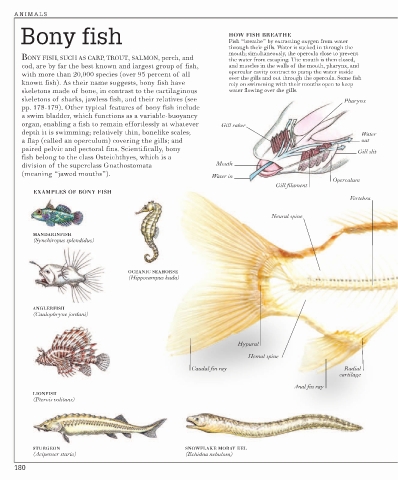
       Bony fish                                                 HOW FISH BREATHE
                                                                 Fish “breathe” by extracting oxygen from water
                                                                 through their gills. Water is sucked in through the
                                                                 mouth; simultaneously, the opercula close to prevent
       BONY FISH, SUCH AS CARP, TROUT, SALMON, perch, and        the water from escaping. The mouth is then closed,
       cod, are by far the best known and largest group of fish,   and muscles in the walls of the mouth, pharynx, and
                                                                 opercular cavity contract to pump the water inside
       with more than 20,000 species (over 95 percent of all
                                                                 over the gills and out through the opercula. Some fish
       known fish). As their name suggests, bony fish have       rely on swimming with their mouths open to keep
       skeletons made of bone, in contrast to the cartilaginous   water flowing over the gills.
       skeletons of sharks, jawless fish, and their relatives (see                               Pharynx
       pp. 178-179). Other typical features of bony fish include
       a swim bladder, which functions as a variable-buoyancy
       organ, enabling a fish to remain effortlessly at whatever   Gill raker
       depth it is swimming; relatively thin, bonelike scales;                                       Water
       a flap (called an operculum) covering the gills; and                                          out
       paired pelvic and pectoral fins. Scientifically, bony
                                                                                                    Gill slit
       fish belong to the class Osteichthyes, which is a
       division of the superclass Gnathostomata              Mouth
       (meaning “jawed mouths”).
                                                            Water in
                                                                                             Operculum
                                                                              Gill filament
          EXAMPLES OF BONY FISH
                                                                                                  Vertebra
                                                                            Neural spine

          MANDARINFISH
          (Synchiropus splendidus)


                                     OCEANIC SEAHORSE
                                     (Hippocampus kuda)


          ANGLERFISH
          (Caulophryne jordani)


                                                                   Hypural

                                                                       Hemal spine
                                                      Caudal fin ray                             Radial
                                                                                               cartilage
                                                                                   Anal fin ray
          LIONFISH
          (Pterois volitans)


          STURGEON                                   SNOWFLAKE MORAY EEL
          (Acipenser sturio)                         (Echidna nebulosa)
     180

