


Page 18 - Ultimate Visual Dictionary (DK)
P. 18
THE UNIVERSE

       Nebulae and star clusters


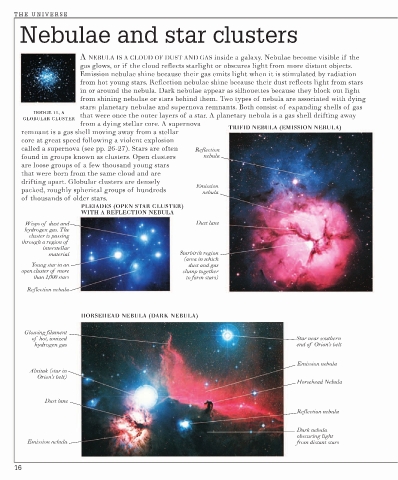
                       A NEBULA IS A CLOUD OF DUST AND GAS inside a galaxy. Nebulae become visible if the
                       gas glows, or if the cloud reflects starlight or obscures light from more distant objects.
                       Emission nebulae shine because their gas emits light when it is stimulated by radiation
                       from hot young stars. Reflection nebulae shine because their dust reflects light from stars
                       in or around the nebula. Dark nebulae appear as silhouettes because they block out light
                       from shining nebulae or stars behind them. Two types of nebula are associated with dying
                       stars: planetary nebulae and supernova remnants. Both consist of expanding shells of gas
          HODGE 11, A
                       that were once the outer layers of a star. A planetary nebula is a gas shell drifting away
       GLOBULAR CLUSTER
                       from a dying stellar core. A supernova
                                                                TRIFID NEBULA (EMISSION NEBULA)
       remnant is a gas shell moving away from a stellar
       core at great speed following a violent explosion
       called a supernova (see pp. 26-27). Stars are often   Reflection
       found in groups known as clusters. Open clusters    nebula
       are loose groups of a few thousand young stars
       that were born from the same cloud and are
       drifting apart. Globular clusters are densely
                                                       Emission
       packed, roughly spherical groups of hundreds      nebula
       of thousands of older stars.
                        PLEIADES (OPEN STAR CLUSTER)
                        WITH A REFLECTION NEBULA
        Wisps of  dust and                             Dust lane
        hydrogen gas. The
         cluster is passing
       through a region of
             interstellar
               material                            Starbirth region
                                                    (area in which
          Young star in an                           dust and gas
       open cluster of  more                        clump together
          than 1,000 stars                           to form stars)
         Reflection nebula


                        HORSEHEAD NEBULA (DARK NEBULA)

        Glowing filament
          of  hot, ionized                                                         Star near southern
           hydrogen gas                                                            end of  Orion’s belt


                                                                                    Emission nebula
         Alnitak (star in
           Orion’s belt)
                                                                                   Horsehead Nebula

             Dust lane
                                                                                   Reflection nebula

                                                                                   Dark nebula
                                                                                   obscuring light
         Emission nebula                                                           from distant stars


     16

