


Page 236 - Ultimate Visual Dictionary (DK)
P. 236
THE HUMAN BODY
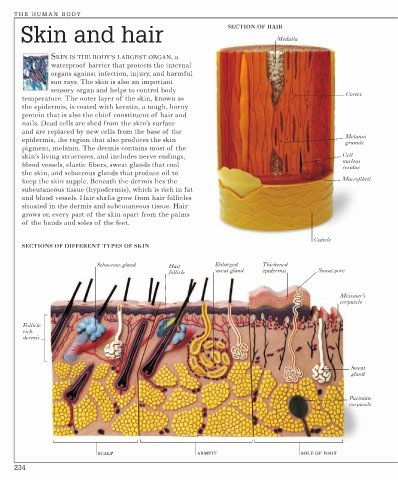
       Skin and hair                                            SECTION OF HAIR
                                                                              Medulla

               SKIN IS THE BODY’S LARGEST ORGAN, a
               waterproof barrier that protects the internal
               organs against infection, injury, and harmful
               sun rays. The skin is also an important
               sensory organ and helps to control body
                                                                                                 Cortex
       temperature. The outer layer of the skin, known as
       the epidermis, is coated with keratin, a tough, horny
       protein that is also the chief constituent of hair and
       nails. Dead cells are shed from the skin’s surface
       and are replaced by new cells from the base of the
                                                                                                 Melanin
       epidermis, the region that also produces the skin
                                                                                                 granule
       pigment, melanin. The dermis contains most of the
       skin’s living structures, and includes nerve endings,                                    Cell
                                                                                                nucleus
       blood vessels, elastic fibers, sweat glands that cool
                                                                                                residue
       the skin, and sebaceous glands that produce oil to
       keep the skin supple. Beneath the dermis lies the                                        Macrofibril
       subcutaneous tissue (hypodermis), which is rich in fat
       and blood vessels. Hair shafts grow from hair follicles
       situated in the dermis and subcutaneous tissue. Hair
       grows on every part of the skin apart from the palms
       of the hands and soles of the feet.

                                                                                        Cuticle
       SECTIONS OF DIFFERENT TYPES OF SKIN


                            Sebaceous gland     Hair         Enlarged     Thickened
                                                follicle     sweat gland  epidermis      Sweat pore


                                                                                               Meissner’s
                                                                                               corpuscle


       Follicle-
       rich
       dermis


                                                                                                   Sweat
                                                                                                   gland


                                                                                                  Pacinian
                                                                                                  corpuscle


                            SCALP                       ARMPIT                       SOLE OF FOOT

     234

