


Page 24 - Ultimate Visual Dictionary (DK)
P. 24
THE UNIVERSE

       Stars


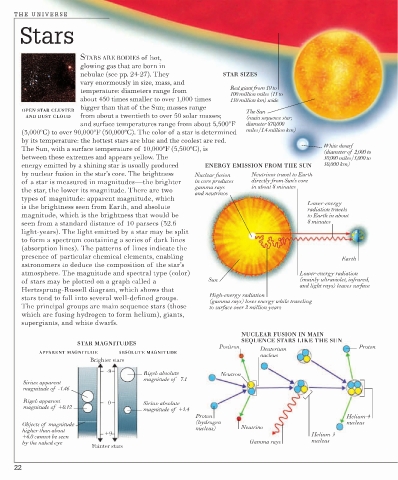
                       STARS ARE BODIES of hot,
                       glowing gas that are born in
                       nebulae (see pp. 24-27). They           STAR SIZES
                       vary enormously in size, mass, and
                                                                 Red giant from 10 to
                       temperature: diameters range from
                                                                 100 million miles (15 to
                       about 450 times smaller to over 1,000 times   150 million km) wide
                       bigger than that of the Sun; masses range
       OPEN STAR CLUSTER                                             The Sun
        AND DUST CLOUD  from about a twentieth to over 50 solar masses;   (main sequence star;
                       and surface temperatures range from about 5,500ºF   diameter 870,000
       (3,000ºC) to over 90,000ºF (50,000ºC). The color of a star is determined   miles/1.4 million km)
       by its temperature: the hottest stars are blue and the coolest are red.
                                                                                           White dwarf
       The Sun, with a surface temperature of 10,000ºF (5,500ºC), is
                                                                                           (diameter of  2,000 to
       between these extremes and appears yellow. The                                      30,000 miles/3,000 to
       energy emitted by a shining star is usually produced   ENERGY EMISSION FROM THE SUN  50,000 km)
       by nuclear fusion in the star’s core. The brightness    Nuclear fusion   Neutrinos travel to Earth
       of a star is measured in magnitudes—the brighter   in core produces   directly from Sun’s core
                                                       gamma rays      in about 8 minutes
       the star, the lower its magnitude. There are two
                                                       and neutrinos
       types of magnitude: apparent magnitude, which
                                                                                      Lower-energy
       is the brightness seen from Earth, and absolute
                                                                                      radiation travels
       magnitude, which is the brightness that would be                               to Earth in about
       seen from a standard distance of 10 parsecs (32.6                              8 minutes
       light-years). The light emitted by a star may be split
       to form a spectrum containing a series of dark lines
       (absorption lines). The patterns of lines indicate the
       presence of particular chemical elements, enabling                                       Earth
       astronomers to deduce the composition of the star’s
       atmosphere. The magnitude and spectral type (color)                          Lower-energy radiation
       of stars may be plotted on a graph called a         Sun                      (mainly ultraviolet, infrared,
                                                                                    and light rays) leaves surface
       Hertzsprung-Russell diagram, which shows that
                                                           High-energy radiation
       stars tend to fall into several well-defined groups.
                                                           (gamma rays) loses energy while traveling
       The principal groups are main sequence stars (those    to surface over 2 million years
       which are fusing hydrogen to form helium), giants,
       supergiants, and white dwarfs.
                                                                    NUCLEAR FUSION IN MAIN
                                                                    SEQUENCE STARS LIKE THE SUN
                       STAR MAGNITUDES
                                                              Positron   Deuterium                   Proton
            APPARENT MAGNITUDE    ABSOLUTE MAGNITUDE
                                                                         nucleus
                          Brighter stars
                               -9        Rigel: absolute      Neutron
                                         magnitude of  -7.1
       Sirius: apparent
       magnitude of  -1.46
       Rigel: apparent         0         Sirius: absolute
       magnitude of  +0.12
                                         magnitude of  +1.4
                                                       Proton                                    Helium-4
                                                       (hydrogen                                 nucleus
       Objects of  magnitude                                        Neutrino
       higher than about      +9                       nucleus)
       +6.0 cannot be seen                                                              Helium-3
       by the naked eye                                               Gamma rays        nucleus
                           Fainter stars

     22

