


Page 26 - Ultimate Visual Dictionary (DK)
P. 26
THE UNIVERSE

       Small stars
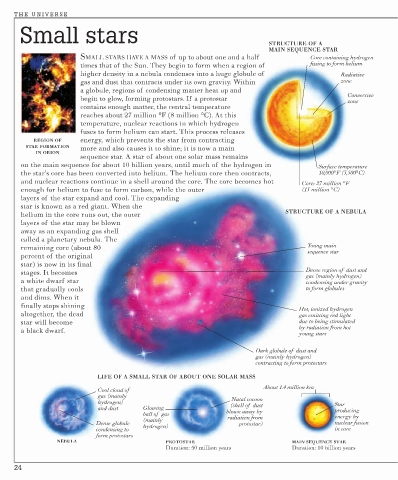
                                                                            STRUCTURE OF A
                                                                            MAIN SEQUENCE STAR
                       SMALL STARS HAVE A MASS of up to about one and a half           Core containing hydrogen
                       times that of the Sun. They begin to form when a region of      fusing to form helium
                       higher density in a nebula condenses into a huge globule of              Radiative
                       gas and dust that contracts under its own gravity. Within                zone
                       a globule, regions of condensing matter heat up and
                                                                                                  Convective
                       begin to glow, forming protostars. If a protostar
                                                                                                  zone
                       contains enough matter, the central temperature
                       reaches about 27 million °F (8 million °C). At this
                       temperature, nuclear reactions in which hydrogen
                       fuses to form helium can start. This process releases
          REGION OF    energy, which prevents the star from contracting
        STAR FORMATION
                       more and also causes it to shine; it is now a main
           IN ORION
                       sequence star. A star of about one solar mass remains
       on the main sequence for about 10 billion years, until much of the hydrogen in     Surface temperature
       the star’s core has been converted into helium. The helium core then contracts,    10,000°F (5,500°C)
       and nuclear reactions continue in a shell around the core. The core becomes hot   Core: 27 million °F
       enough for helium to fuse to form carbon, while the outer                     (15 million °C)
       layers of the star expand and cool. The expanding
       star is known as a red giant. When the
                                                                                STRUCTURE OF A NEBULA
       helium in the core runs out, the outer
       layers of the star may be blown
       away as an expanding gas shell
       called a planetary nebula. The
       remaining core (about 80                                                       Young main
                                                                                      sequence star
       percent of the original
       star) is now in its final
                                                                                      Dense region of  dust and
       stages. It becomes
                                                                                      gas (mainly hydrogen)
       a white dwarf star                                                             condensing under gravity
       that gradually cools                                                           to form globules
       and dims. When it
       finally stops shining
                                                                                    Hot, ionized hydrogen
       altogether, the dead                                                         gas emitting red light
       star will become                                                             due to being stimulated
                                                                                    by radiation from hot
       a black dwarf.
                                                                                    young stars
                                                                        Dark globule of  dust and
                                                                        gas (mainly hydrogen)
                                                                        contracting to form protostars
                            LIFE OF A SMALL STAR OF ABOUT ONE SOLAR MASS
                                                                          About 1.4 million km
                            Cool cloud of
                            gas (mainly                          Natal cocoon
                            hydrogen)                                                         Star
                                                                 (shell of  dust
                            and dust     Glowing                blown away by                 producing
                                         ball of  gas                                         energy by
                                         (mainly                radiation from
                            Dense globule   hydrogen)              protostar)                 nuclear fusion
                            condensing to                                                     in core
                            form protostars
                 NEBULA                        PROTOSTAR                          MAIN SEQUENCE STAR
                                               Duration: 50 million years         Duration: 10 billion years
     24

