


Page 28 - Ultimate Visual Dictionary (DK)
P. 28
THE UNIVERSE

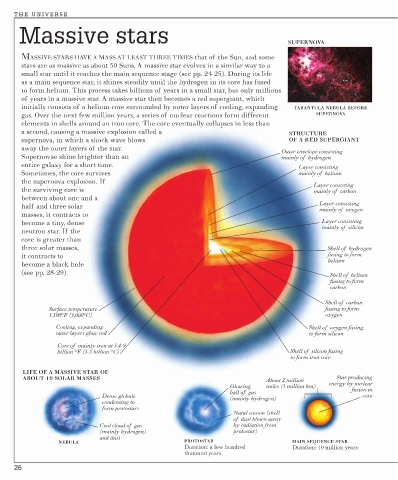
      Massive stars                                                              SUPERNOVA


       MASSIVE STARS HAVE A MASS AT LEAST THREE TIMES that of the Sun, and some
       stars are as massive as about 50 Suns. A massive star evolves in a similar way to a
       small star until it reaches the main sequence stage (see pp. 24-25). During its life
       as a main sequence star, it shines steadily until the hydrogen in its core has fused
       to form helium. This process takes billions of years in a small star, but only millions
       of years in a massive star. A massive star then becomes a red supergiant, which
       initially consists of a helium core surrounded by outer layers of cooling, expanding   TARANTULA NEBULA BEFORE
       gas. Over the next few million years, a series of nuclear reactions form different   SUPERNOVA
       elements in shells around an iron core. The core eventually collapses in less than
       a second, causing a massive explosion called a                            STRUCTURE
       supernova, in which a shock wave blows                                    OF A RED SUPERGIANT
       away the outer layers of the star.
                                                                               Outer envelope consisting
       Supernovae shine brighter than an                                       mainly of  hydrogen
       entire galaxy for a short time.                                              Layer consisting
       Sometimes, the core survives                                                 mainly of  helium
       the supernova explosion. If
                                                                                        Layer consisting
       the surviving core is                                                            mainly of  carbon
       between about one and a
                                                                                          Layer consisting
       half and three solar
                                                                                          mainly of  oxygen
       masses, it contracts to
       become a tiny, dense                                                               Layer consisting
                                                                                          mainly of  silicon
       neutron star. If the
       core is greater than
       three solar masses,                                                                  Shell of  hydrogen
       it contracts to                                                                      fusing to form
                                                                                            helium
       become a black hole
       (see pp. 28-29).
                                                                                             Shell of  helium
                                                                                             fusing to form
                                                                                             carbon
                                                                                           Shell of  carbon
               Surface temperature                                                         fusing to form
               5,500°F (3,000°C)                                                           oxygen
                 Cooling, expanding                                                    Shell of  oxygen fusing
                 outer layers glow red                                                 to form silicon

                 Core of  mainly iron at 5.4-9
                 billion °F (3-5 billion °C)                                      Shell of  silicon fusing
                                                                                  to form iron core
       LIFE OF A MASSIVE STAR OF
       ABOUT 10 SOLAR MASSES                                                                   Star producing
                                                                           About 2 million
                                                                 Glowing   miles (3 million km)  energy by nuclear
                                                                                                   fusion in
                                                                 ball of  gas
                             Dense globule                       (mainly hydrogen)                    core
                             condensing to
                             form protostars
                                                                  Natal cocoon (shell
                                                                  of  dust blown away
                             Cool cloud of  gas                   by radiation from
                             (mainly hydrogen)                    protostar)
                             and dust
                 NEBULA                             PROTOSTAR                     MAIN SEQUENCE STAR
                                                    Duration: a few hundred       Duration: 10 million years
                                                    thousand years
     26

